Mise en place at home means reading the whole recipe, preparing what it needs, and arranging ingredients and equipment in a usable order before cooking. You do not need a separate bowl for every ingredient. Group items that enter the pan together, keep different additions separate, and leave temperature-sensitive ingredients in suitable storage until needed.
This is preparation for one cooking session, rather than a plan to cook the entire week’s meals. You will turn a recipe into a short sequence, set up a compact workstation, and work through an illustrative chickpea-skillet example. The useful result is knowing what comes next when the pan is hot.
Key Takeaways
- Read the method as well as the ingredient list before preparing anything.
- Group ingredients by when they are added, not simply by whether they are vegetables or spices.
- Gather equipment and clear the working area before turning on the heat.
- Keep temperature-sensitive foods appropriately stored and bring out what you are actively using.
What does mise en place mean in an ordinary home kitchen?
Picture starting to cook an onion, then discovering that the next step needs drained chickpeas, measured spices, and chopped tomatoes. The problem is not necessarily slow chopping. Your attention has been divided between food already cooking and preparation that still needs doing.
Mise en place gives that preparation a place before the time-sensitive work. The National CACFP Association resource from the Institute of Child Nutrition includes ingredients, tools, planning, and the order of work. It is more useful than a photograph of neatly filled containers.
At home, the setup can be small: a clear board, a stable pan, a spoon, a few measured ingredients, and a recipe you can read without moving everything. The standard is that the next action is possible, not that the counter resembles a television studio.
It also differs from menu planning. Meal planning for one person concerns what you will eat across several meals. Mise en place concerns how you will prepare the particular meal in front of you. Doing one does not automatically complete the other.
How do you turn a recipe into a preparation sequence?
Read from beginning to end before chopping. Mark preparation hidden in the ingredient list, such as ‘onion, finely diced’ or ‘beans, drained.’ Then look for instructions in the method that demand additional work: reserving liquid, dividing an ingredient, or preheating equipment.
Identify what enters together and what must wait. Garlic may appear beside onion in the ingredient list but enter the pan later. A finishing herb may need to stay separate even though it is another chopped green ingredient.
- Confirm the portions, ingredients, and any substitutions before starting.
- Write the additions in cooking order: first, next, later, and finish.
- Identify divided quantities so you do not add the full amount too early.
- Check equipment, including strainers, measuring tools, and serving dishes.
- Prepare the items needed before the first time-sensitive step.
If you need a different number of servings, scale the recipe before measuring. Changing quantities halfway through preparation creates avoidable uncertainty about which amounts were already adjusted.
The MICHELIN Guide’s explanation of mise en place emphasizes reading and organizing before cooking. Your version can be a few pencil marks on the recipe. Use the smallest plan that still makes the sequence unambiguous.
Which tools and containers do you actually need?
Choose containers according to timing and compatibility. Two dry spices added at the same moment can often share a small dish. Ingredients added at different stages should remain distinguishable even when combining them would save a bowl.
A plate can hold separate piles of prepared vegetables if there is sufficient clean space and the ingredients can safely share the surface. A strainer may hold drained chickpeas over a suitable dish until they are needed. Do not balance tools precariously to save counter space.
Gather a utensil for stirring and somewhere clean for it to rest. Check that the pan fits the burner and that the handle will not project into a busy walkway. A complete ingredient setup is little help if you still have to search for the only usable spoon.
Use containers you already own rather than buying a matching set. A tray can keep a small group together, but avoid crowding the work area. Put packaging away once you have verified the amount and retained any instructions you still need.
What does a complete chickpea-skillet setup look like?
Map the ingredients to the order of work
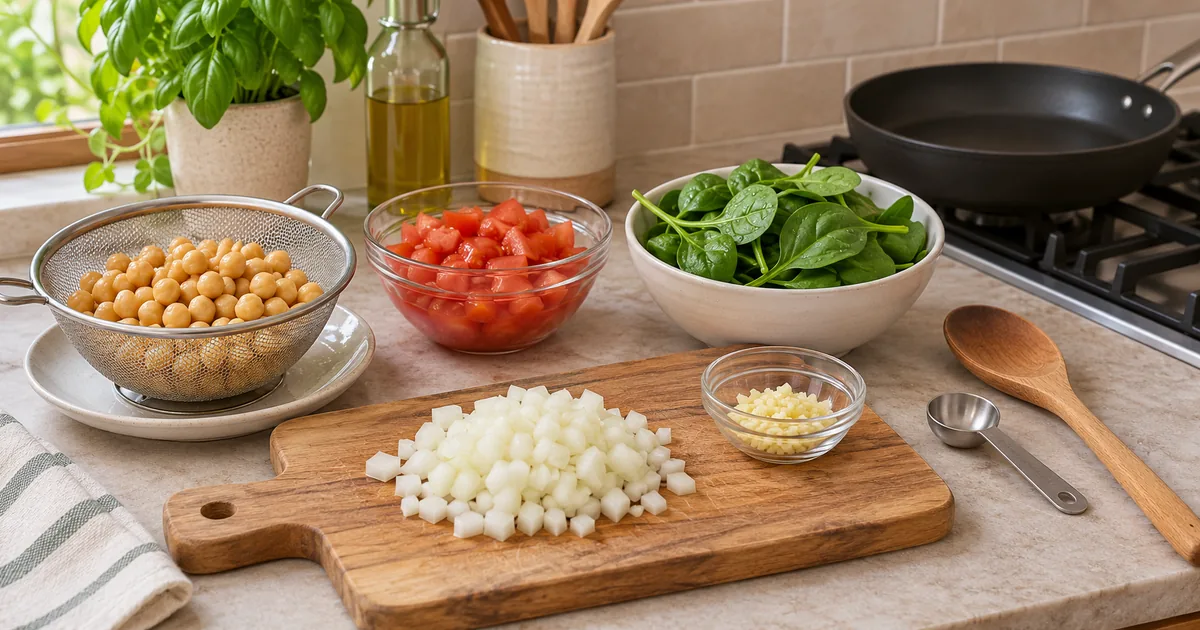
Imagine you are following a two-serving chickpea, tomato, and spinach skillet recipe. This is an original preparation example, not a tested recipe or a description of a recipe inside an ebook. Use the quantities and cooking directions from the actual recipe you have chosen.
Suppose that method calls for onion first, garlic and spices next, chickpeas and tomatoes afterward, and spinach near the end. Your preparation should preserve those distinctions.
| Recipe component | Preparation station | Why it stays there |
|---|---|---|
| Onion | Diced on a clean board or in one dish | It enters first |
| Garlic and dry spices | Measured, separately or together if the method adds them together | They enter after the onion |
| Chickpeas and tomatoes | Chickpeas drained; tomatoes prepared and measured | They are ready for the main addition |
| Spinach | Prepared as directed and kept separate | It enters later rather than simmering with everything |
| Finishing ingredients | Measured and clearly set aside | They are not accidentally added with the cooking ingredients |
Check the setup before turning on the heat
The cook notices that the recipe also requires a little reserved chickpea liquid. Draining directly into the sink would lose it, so the strainer is placed over a bowl and the specified amount is measured first. Reading the full method changes the preparation decision before it causes a problem.
Next, the cook checks the pan, spoon, and access to the recipe. The onion is ready, the later additions are identifiable, and the counter has room to work. The result is a station that follows the recipe’s actual sequence, not five bowls arranged only for appearance.
If you want a recipe source after practicing the method, The High Protein Recipe is a related catalog resource. Apply the same preparation check to whichever recipe you select rather than assuming every dish follows the skillet sequence.
What should wait until later in the process?
Mise en place does not require leaving every ingredient on the counter throughout preparation. The ICN resource advises keeping foods you are actively working with at the station and organizing other items in temperature-appropriate storage. Readiness includes knowing where an ingredient is waiting.
Avoid bringing out a refrigerated ingredient merely because it looks tidy beside the dry ingredients. Note when it is needed and keep it suitably stored until then. If your recipe requires a specific preparation or food-safety step, follow that instruction rather than a generic arrangement.
Some tasks can happen during a genuinely passive stage, but choose them deliberately. Reading a new recipe for the first time while something cooks is different from measuring a finishing ingredient you already know about. When you are learning a dish, prepare more of the sequence in advance.
A later step can also require a clean tool or surface. Plan that reset rather than assuming the board used for earlier work remains suitable. The preparation checklist should include cleanliness and separation where required by the ingredients, not just chopping and measuring.
How do you fix the mistakes that make preparation feel slower?
If you create too much washing up, revisit the addition order. Combine compatible ingredients only when they enter together, and use the right-sized container. Do not save a bowl by mixing ingredients that later need to be separated.
If you keep forgetting an ingredient, tick it off as it is measured or prepared. For a divided ingredient, write two separate amounts beside the relevant steps. A clear note is safer than remembering that ‘some of it goes in later.’
If preparation feels endless, start with one familiar meal and identify the few items that must be ready before cooking. You do not need to chop ingredients for unrelated meals or reorganize the entire pantry during the session.
Finally, review the result after eating. Did you search for a tool, lose a reserved liquid, or have too much prepared for the pan? Record one change on the recipe. That small correction makes the next setup more useful than repeating an arrangement that only looked organized.
Conclusion
Before your next meal, read the entire recipe and write its additions in order. Gather the tools, prepare the first time-sensitive sequence, and keep later ingredients identifiable and appropriately stored. Turn on the heat only when you can explain what happens next without searching the kitchen.
Frequently Asked Questions
Is mise en place useful when cooking without a recipe?
Yes. Write your intended sequence before beginning and check the ingredients and equipment it requires. You still need a sensible cooking method and appropriate food-safety guidance for the ingredients. The preparation routine helps you carry out that plan; it cannot compensate for an uncertain method or establish whether food is safely cooked.
Should I chop everything the night before?
Not automatically. Advance preparation can change texture or appearance, and storage needs depend on the ingredient. Check guidance for the particular food and recipe before preparing it early. You can still do useful planning in advance by reading the method, checking equipment, and identifying which steps should wait until the cooking session.