An AI answer appears on your screen in seconds. Behind it, physical machines move data, run calculations, consume electricity, and release heat. The software may feel weightless. The infrastructure is anything but.
That connection explains why AI and data centers belong in the same conversation. Building useful AI involves more than designing a capable model. It also requires enough computing capacity, dependable power, fast networking, and cooling that can keep equipment operating safely.
For business owners and curious readers, understanding this infrastructure helps answer practical questions: Why do AI services have usage limits? Why can video generation cost more than a short text response? And what makes an AI service efficient beyond an attractive subscription price?
This guide follows an AI request into the data center, explains the main energy and cooling challenges, and shows how businesses can use AI more thoughtfully.
What Is an AI Data Center?
An AI data center is a facility equipped to run artificial intelligence workloads, including model training and inference. It combines computing hardware, storage, networking, electrical systems, and cooling. Some facilities specialize in AI; others support AI alongside conventional cloud services.
There is no universal building type called an AI data center. The term describes the workloads and infrastructure involved. A traditional facility can support some AI applications, while a large training cluster may require a substantially different power, cooling, and network design.
The equipment is only one part of the system. Electricity must reach the servers reliably. Heat must move away from the chips. Storage must deliver data when needed. Networks must connect machines without leaving expensive processors waiting.
| Component | What it does | Why it matters for AI |
|---|---|---|
| CPUs | Coordinate general computing tasks | Prepare data and support applications around the model |
| GPUs and other accelerators | Perform large amounts of parallel computation | Run many of the mathematical operations used in modern AI |
| High-speed networks | Exchange information between machines | Help distributed workloads coordinate their work |
| Storage and memory | Hold datasets, model parameters, and working data | Keep computing resources supplied with information |
| Power and cooling systems | Deliver electricity and remove heat | Allow equipment to operate within its limits |
The best-known hardware may be the accelerator, but the performance of the entire system depends on how these parts work together.
How AI Uses Data Centers: Training vs. Inference
Two different activities drive much of the discussion about AI infrastructure.
Training: Building a model’s capabilities
During training, a model processes examples and adjusts its internal parameters. A large training run can involve many accelerators working together, repeatedly exchanging information as learning progresses.
One way to picture this is a team assembling a complex reference system. The team must examine material, compare results, and revise the system repeatedly. The work happens before most users interact with the finished product.
Training requirements vary enormously. Developing a large general-purpose model is a different infrastructure problem from adapting a smaller model for a narrow business task.
Inference: Using a trained model
Inference happens when a trained model produces an output: an answer, a classification, an image, a transcription, or another result.
A customer support assistant uses inference each time it generates a reply. A meeting transcription service uses inference as it processes speech. A document extraction tool uses inference when it identifies information in an uploaded file.
For a widely used service, repeated inference becomes a continuing operating requirement. Its total impact depends on the number and complexity of requests, the model used, and how efficiently the service runs.
Training creates or changes capabilities; inference applies them. Both matter, and their relative contribution depends on the application and its usage.
Why AI Can Require So Much Electricity
Modern AI workloads can involve substantial computation, particularly when they use large models, process extensive inputs, or generate demanding outputs. Electricity also supports memory, networking, storage, and the systems that keep the facility running.
The International Energy Agency’s 2025 Energy and AI report estimated that all data centers worldwide used about 415 terawatt-hours of electricity in 2024, roughly 1.5% of global electricity consumption. Its base case projected consumption of around 945 TWh by 2030. These figures cover data centers overall, rather than AI alone, and the future figure is a projection. Source: IEA executive summary.
That distinction matters. A headline about data center electricity is not automatically a measurement of AI electricity use. Data centers also support websites, business software, streaming, databases, and many other digital services.
Power and energy measure different things
Power describes the rate at which electricity is used, commonly expressed in kilowatts or megawatts. Energy describes the amount consumed over time, commonly expressed in kilowatt-hours or terawatt-hours.
For example, equipment drawing a steady 10 kilowatts for one hour uses 10 kilowatt-hours. If it runs for ten hours at the same draw, it uses 100 kilowatt-hours.
This simple distinction makes infrastructure claims easier to assess. A proposed facility’s capacity does not tell you exactly how much electricity it will consume over a year. Operating hours, utilization, and supporting systems affect the result.
Why there is no universal energy cost per prompt
A short text classification and a detailed video generation task are different computational jobs. Even two text requests can vary because of input length, output length, model architecture, hardware, and the number of additional steps the application performs.
Be cautious with claims that every AI prompt uses one fixed amount of electricity. A useful estimate needs a defined workload and a clear measurement boundary: does it include just the accelerator, the server, the facility, or a broader system?
Cooling AI Data Centers: Where the Heat Goes
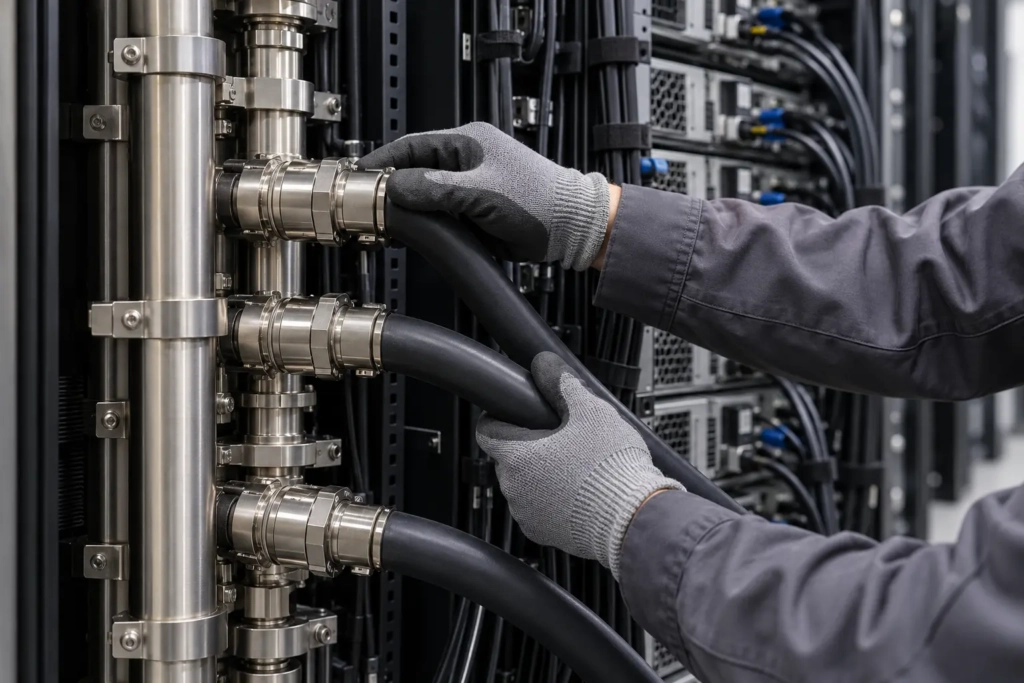
Computing equipment converts much of the electricity it consumes into heat. That heat must be removed to keep components within safe operating temperatures.
Air cooling moves heat away using airflow through and around equipment. Liquid cooling brings a liquid heat-transfer medium closer to hot components. In direct-to-chip systems, cold plates collect heat from selected components and transfer it into a cooling loop.
Liquid cooling does not mean liquid runs through the computer chips themselves. It also does not describe how the facility ultimately rejects heat outdoors. Those are separate design questions.
As more computing power is concentrated into a rack, the cooling design becomes more demanding. Operators must consider component temperatures, flow rates, maintenance, equipment compatibility, and how the building removes collected heat.
Does liquid cooling eliminate water use?
Not automatically. A server-side liquid loop and a facility’s outdoor heat-rejection system are different parts of the cooling chain.
A closed loop can circulate coolant repeatedly while other equipment elsewhere in the facility consumes water. Conversely, some heat-rejection designs can reduce direct water consumption, with tradeoffs that depend on climate, temperatures, and electricity use.
The practical question is therefore more specific than “Does this data center use liquid cooling?” Ask how the complete cooling system works, where water is consumed, and how local conditions affect the design.
Electricity Grids Can Shape AI Expansion
Ordering servers does not guarantee that a site can power them. A data center needs a suitable electricity connection, adequate local network capacity, and a credible path to reliable operation.
The IEA’s 2025 report identifies grid connection queues and long infrastructure lead times as constraints on expansion. Its analysis describes transmission construction and equipment availability as potential bottlenecks. Source: IEA executive summary.
This creates a useful way to understand the industry: available computing capacity depends on coordinated delivery. A building, a hardware shipment, a power connection, and a cooling installation must become operational together.
For local communities, the relevant questions also extend beyond the building. How will the project affect electricity demand in the area? What upgrades are required? What are the site’s water requirements? How will noise and backup power operation be managed?
The answers depend on the project. Global electricity totals cannot substitute for a local assessment.
Are AI Data Centers Sustainable?
Sustainability is not a single feature that a facility either has or lacks. It requires looking at several connected measures.
| Measure | What it helps assess | What it cannot establish alone |
|---|---|---|
| Electricity consumption | Total energy demand over a stated period | The emissions associated with that electricity |
| Power usage effectiveness, or PUE | Facility energy overhead relative to IT energy | Whether the AI workload itself is useful or efficient |
| Water reporting | Water use within a defined boundary | Local environmental significance without context |
| Electricity sourcing | How power is procured or supplied | Hour-by-hour matching unless explicitly demonstrated |
| Hardware lifecycle | Manufacturing, service life, and disposal considerations | The full environmental outcome without operating data |
PUE is calculated by dividing total facility energy by IT equipment energy. A hypothetical PUE of 1.2 means the facility uses 1.2 units of energy for each unit delivered to IT equipment.
However, PUE does not judge the quality of the computing work. A facility can have low overhead while its servers perform unnecessary tasks. Conversely, a useful workload still has an impact that should be measured.
Renewable electricity claims also need a clear boundary. Buying an annual quantity of renewable electricity is a different claim from matching a facility’s consumption with carbon-free supply every hour. Readers should look for what was measured, over which period, and in which region.
Can AI Improve Data Center Efficiency?
AI can support operational analysis by identifying patterns in equipment readings, estimating future loads, and helping operators investigate unusual behavior. Potential applications include cooling controls, maintenance planning, and workload scheduling.
Those possibilities should be evaluated with the same discipline as other engineering changes. A promising simulation is not the same as a verified improvement in operation.
Three questions help assess an efficiency claim:
- What was the baseline? Compare against a defined operating condition.
- What changed besides the AI system? Weather, utilization, and equipment upgrades can affect results.
- What happened to total consumption? Better efficiency per task can coexist with higher consumption if activity grows.
This last point is especially useful. A service may become cheaper and more efficient to run, encouraging more people to use it. Efficiency improvements and demand growth can occur together.

What Small Businesses Should Do With This Information
Most small businesses will consume AI through software or cloud services. Their practical opportunity is to design better workflows and ask better questions of providers.
Match the model to the task
A routine classification or extraction task may not need the same model as a complex analysis. Compare options using representative examples and a quality threshold that your business can explain.
The aim is the lowest resource and financial cost that consistently delivers acceptable results. A smaller model that requires repeated corrections may be a poor choice for a particular workflow.
Remove avoidable repeated work
Consider an online bookshop that classifies customer messages, drafts product descriptions, and answers common questions. It can use fixed rules for opening hours, reuse approved responses to recurring questions, and reserve generative AI for work that benefits from it.
It can also retrieve relevant passages from its own documentation instead of sending an entire document collection with every request. This is an illustrative workflow, not a guaranteed saving: retrieval quality, maintenance, and implementation costs still matter.
Measure accepted results
Track cost per approved product description, resolved support request, or correctly processed document. Include retries and human review.
A low price per request is less useful if each successful outcome requires several attempts. Business value depends on the completed task.
Ask providers specific questions
Before adopting a service, ask about data retention, processing locations, model options, usage reporting, and any environmental disclosures relevant to your requirements. Distinguish provider-wide sustainability statements from information that actually applies to the service you use.
For a related practical guide, read How Can a Small Business Use AI Automation Without Hiring a Developer?.
Frequently Asked Questions
What is the relationship between AI and data centers?
Data centers provide the computing, storage, networking, power, and cooling that support many AI services. AI workloads, in turn, influence how facilities are designed and operated.
Do all data centers run AI?
No. Data centers support many digital services. Some specialize in AI workloads, while others host a mixture of AI and conventional computing.
Why do AI servers use GPUs?
GPUs can perform many calculations in parallel, which suits many operations used in modern AI. Other accelerators and CPUs also play roles, depending on the workload.
Do AI data centers use water?
Some cooling systems consume water directly. The amount depends on the facility and local conditions. Electricity generation can also involve water use, so any estimate should state its boundary.
Is every AI request equally energy-intensive?
No. Requirements vary with the model, input and output length, task, hardware, and service configuration. A universal figure per prompt can hide important differences.
Can small businesses use AI more efficiently?
Yes. They can test suitable models, reduce repeated processing, reuse approved outputs where appropriate, and measure cost and quality per completed task.
A Better Way to Think About AI Infrastructure
AI connects software decisions to physical resources. The model matters, but so do the servers that run it, the electricity that powers them, and the cooling that removes their heat.
For businesses, the most useful response is practical: define the task, choose suitable tools, measure completed outcomes, and remove unnecessary processing. For readers evaluating environmental claims, look for clear boundaries and distinguish measured results from projections.
Explore BestDigiBooks for practical reading on business, AI, and digital skills, and build your next workflow around a problem worth solving.