
You pick up your phone to check one thing. A few videos later, the evening has moved on, and the thing you actually wanted to do is still waiting.
You do not need an elaborate digital detox to spend the next twenty minutes differently. A pencil, a few scraps of paper, or an instrument you already own can give your hands something more interesting to do.
There is growing editorial interest in this idea. In 2026, TODAY covered beginner-friendly analog activities, while ELLE explored the appeal of hands-on hobbies. But you do not have to follow a trend to enjoy making something.
These seven screen-free hobbies for adults are deliberately small. Each starts with a manageable project, minimal supplies, and permission to be a beginner. Pick one for tonight. Read the instructions, put your phone somewhere inconvenient, and see what happens when the next twenty minutes belong to you.
Which Screen-Free Hobby Should You Try First?
Choose according to what is already available, rather than shopping for the person you hope to become.
| If you want to… | Try… | What you need to begin |
|---|---|---|
| Make something with almost no preparation | Pencil drawing | Pencil, paper, a household object |
| Work with color | Acrylic painting | Paint, brush, suitable painting surface |
| Make music | Guitar | A playable, tuned guitar |
| Put an idea into words | Creative writing | Paper and a pen |
| Make something useful | Simple cooking | Familiar ingredients and basic kitchen tools |
| Enjoy a quiet story or idea | Reading on paper | A book you already own or can borrow |
| Play without needing drawing skills | Paper collage | Scrap paper, scissors, glue |
If two options appeal equally, choose the one with the easiest setup. The first goal is to begin, not to identify your lifelong passion.
1. Pencil Drawing: Sketch One Ordinary Object
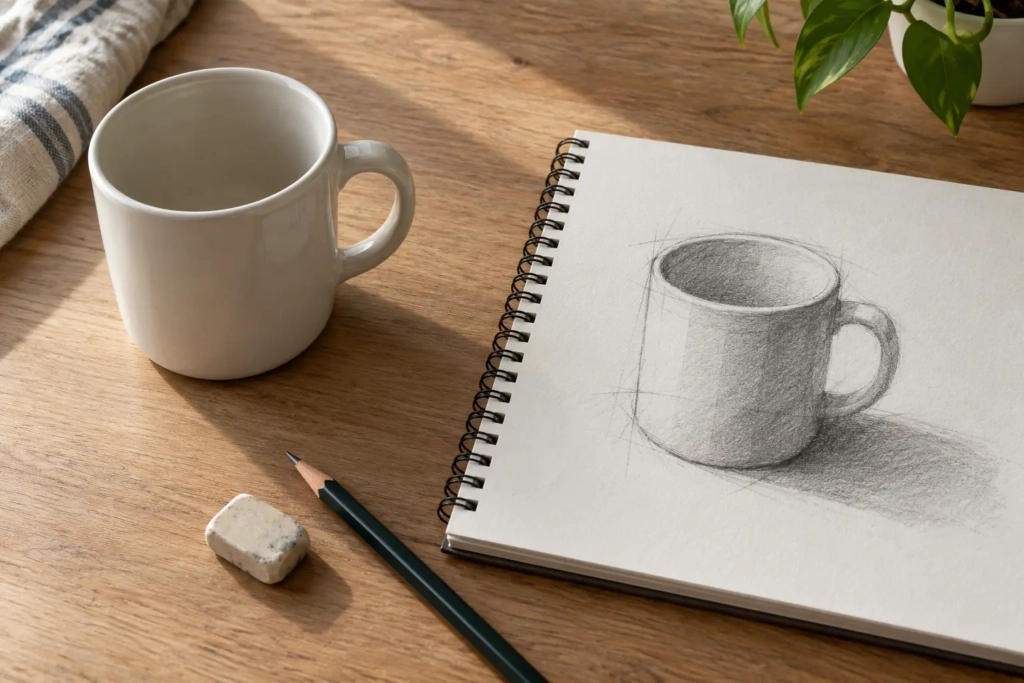
A mug is an excellent first subject. It stays still, costs nothing if you already own one, and offers a useful mixture of curves, edges, and shadows.
Minimum supplies: A regular pencil, paper, and a mug. An eraser is optional.
Your first twenty minutes
Spend the first two minutes looking. Notice how the rim appears oval rather than perfectly round. Compare the mug’s height with its width. Find the lightest area and the darkest shadow.
Next, draw the mug lightly using simple shapes. Leave the decoration alone. Concentrate on the body, the handle, and where the mug meets the table.
Use the remaining time to create three values: the untouched paper for light, light pencil shading for middle tones, and a darker area for the deepest shadow. Make a tiny three-shade swatch beside the drawing if that helps you stay consistent.
A realistic first result: A recognizable mug with an uneven handle and a few believable shadows. That is enough for one session.
Beginner mistake to avoid: Pressing hard immediately. Light construction lines are easier to adjust, and the drawing does not need a heavy outline around every edge.
Try next: Draw the same mug tomorrow from another angle. Compare what you noticed, rather than judging which version looks more impressive.
2. Acrylic Painting: Make a Small Sky Study
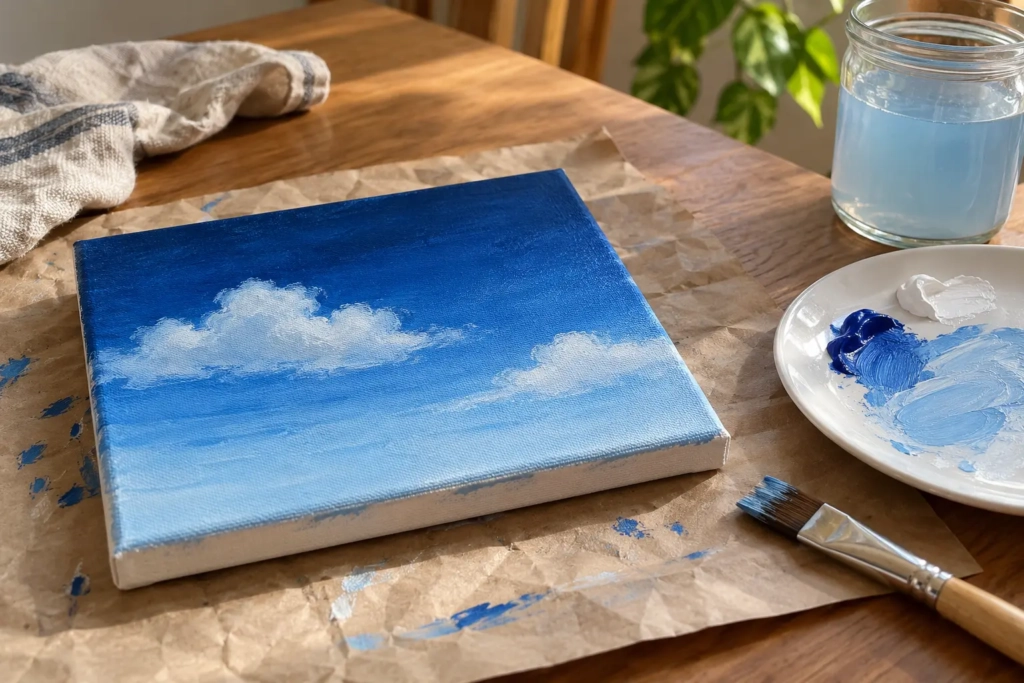
You do not need to paint an entire landscape tonight. A small rectangle of sky is a complete exercise in mixing and placing color.
Minimum supplies: Blue and white acrylic paint, a brush, a water container, a mixing surface, and acrylic paper or a prepared canvas. Add one warm color only if you already have it. Protect the table and follow the paint label’s handling and cleanup instructions.
Your first twenty minutes
Mark out a small area, roughly the size of a postcard. Mix three pools of blue: one darker, one medium, and one mostly white.
Place the darker color near the top and the palest near the bottom. Bring the wet edges together with a few gentle brush passes. Acrylic dries quickly, so work in a small area and stop before repeated brushing begins lifting the paint.
If you want clouds, add two or three pale shapes. Give them varied edges instead of outlining identical white blobs. Leave trees, buildings, and tiny details for another session.
A realistic first result: A simple sky with visible brush marks and a transition between light and dark blue.
Beginner mistake to avoid: Using too many colors. A limited palette makes it easier to understand why a mixture changes.
Try next: Repeat the exercise with a different balance of light and dark. If you enjoy this kind of structured practice, BestDigiBooks’ Canvas Painting for Beginners is a relevant guide to explore for your next steps.
3. Guitar: Practice One Gentle Chord Change
If a guitar is already sitting in the corner, tonight’s goal can be much smaller than learning a song. Try making two chord shapes and moving between them slowly.
Minimum supplies: A playable, tuned guitar and a printed chord reference if needed. You can use a tuner during setup, then put the screen away. The instructions below assume standard tuning: E–A–D–G–B–E, from the thickest string to the thinnest.
Your first fifteen to twenty minutes
Start with E minor: press the A string at the second fret and the D string at the second fret, then gently strum all six strings. Place your fingertips close behind the fret wire rather than directly on top of it.
Next, try A sus2, often written Asus2: press the D and G strings at the second fret, and strum from the A string down. Leave the thickest E string out.
Practice changing between the shapes without strumming. Then try one gentle strum after each change. Slow down enough that you can place your fingers deliberately. Spend the last few minutes listening for strings that ring clearly and adjusting one finger at a time.
A realistic first result: A few clear strums, some buzzing strings, and a slow change between two shapes.
Beginner mistake to avoid: Squeezing harder every time something buzzes. Check finger placement first, relax your shoulders, and take breaks. Stop if playing hurts; do not force a long session.
Try next: Keep the same two chords and make your changes a little smoother. A structured beginner guide, such as BestDigiBooks’ Learn The Guitar, can be a next step if you decide to continue.
4. Creative Writing: Turn a Memory Into One Page
Writing can be a hobby even if nobody else ever reads it. You do not need a plot, a publishing plan, or an important life event. A small remembered scene gives you plenty to work with.
Minimum supplies: Paper and a pen.
Your first fifteen minutes
Choose an ordinary memory: waiting outside school, entering a relative’s kitchen, getting caught in the rain, or hearing a familiar voice from another room.
Write three details before you begin the scene:
- One thing you could see.
- One sound you remember.
- One physical detail, such as heat, texture, or movement.
Now write the scene without explaining its lesson. Instead of saying a kitchen was welcoming, describe the chair someone pulled out for you, the steam from a pot, or the question they asked when you arrived.
Keep moving when a sentence feels awkward. If a detail is uncertain, leave it vague or treat the exercise as fiction rather than presenting an invented memory as fact.
A realistic first result: A page with a few vivid details and some sentences you would change later.
Beginner mistake to avoid: Editing the opening sentence for the entire session. Finish the scene before polishing it.
Try next: Rewrite one paragraph from the viewpoint of someone else in the room, clearly as a fictional exercise.
5. Simple Cooking: Make One Small Thing From What You Have
Cooking becomes a more enjoyable evening activity when it is not an ambitious production. Choose a familiar snack or side dish instead of a complicated recipe with ingredients you need to buy.
Minimum supplies: Ingredients you already know how to handle, a bowl, basic utensils, and a clear work surface.
Your first fifteen to twenty minutes
Try a simple bean salad if the ingredients suit your dietary needs. Combine ready-to-eat canned beans, rinsed and drained according to the label, with chopped cucumber or tomato. Add a little olive oil and lemon juice, then taste before adding more seasoning.
Use this as an exercise in noticing differences. How does a smaller chop change each bite? Does the salad need more acidity, or simply a little more mixing? Keep the adjustments small enough to understand their effect.
If that combination does not appeal, choose another familiar recipe and write it on paper before you begin. Wash produce, use clean utensils, and follow storage instructions for your ingredients.
A realistic first result: Something simple you would happily eat again, plus one adjustment to remember.
Beginner mistake to avoid: Adding several new ingredients at once. You lose track of what improved the dish.
Try next: Record your preferred version on a recipe card, including what you would do differently next time.
6. Reading on Paper: Finish a Small Section
An unfinished book can feel like another task on your list. Make the session smaller: one chapter, a short essay, or a few pages of something you actually want to read.
Minimum supplies: A paper book, borrowed or owned, and an optional pencil and scrap of paper.
Your first twenty minutes
Choose the stopping point before you start. Put the phone beyond easy reach and read toward that point without switching between books.
When you finish, write one sentence: something you noticed, a question you have, or a practical idea you might try. Fiction does not need to produce a lesson; a striking image or a character’s choice is enough.
If you are reading a practical guide, stop after one usable idea rather than collecting ten more instructions. A short reading session followed by practice may fit your evening better than a long session of planning.
A realistic first result: A small section read attentively and one thought worth keeping.
Beginner mistake to avoid: Choosing a book because you think you should like it. Give yourself permission to choose another book if the first is a poor fit.
Try next: Leave the book open at your next starting point, or put a bookmark beside a handwritten question.
7. Paper Collage: Build a Tiny Mood Board
Collage is useful when you want to make something visual without drawing from scratch. Packaging, old magazines, colored paper, and envelopes can all become raw material.
Minimum supplies: Scrap paper, a backing sheet, scissors, and glue. Use scraps you are happy to cut up, and avoid including personal information or valuable originals.
Your first twenty minutes
Pick a loose theme: a quiet morning, a coastal walk, a favorite season, or a room you would like to spend time in.
Choose no more than five main pieces. Arrange them without glue first. Try one large shape, two medium shapes, and a couple of smaller accents. Move them around until the arrangement feels intentional, then attach them.
Leave some of the backing paper visible. Empty space can help individual pieces stand out; you do not need to cover every gap.
A realistic first result: A small composition with a clear mood or color relationship.
Beginner mistake to avoid: Gluing down the first arrangement immediately. Trying a second layout costs almost nothing and can reveal a better balance.
Try next: Use the same theme again with a completely different palette.
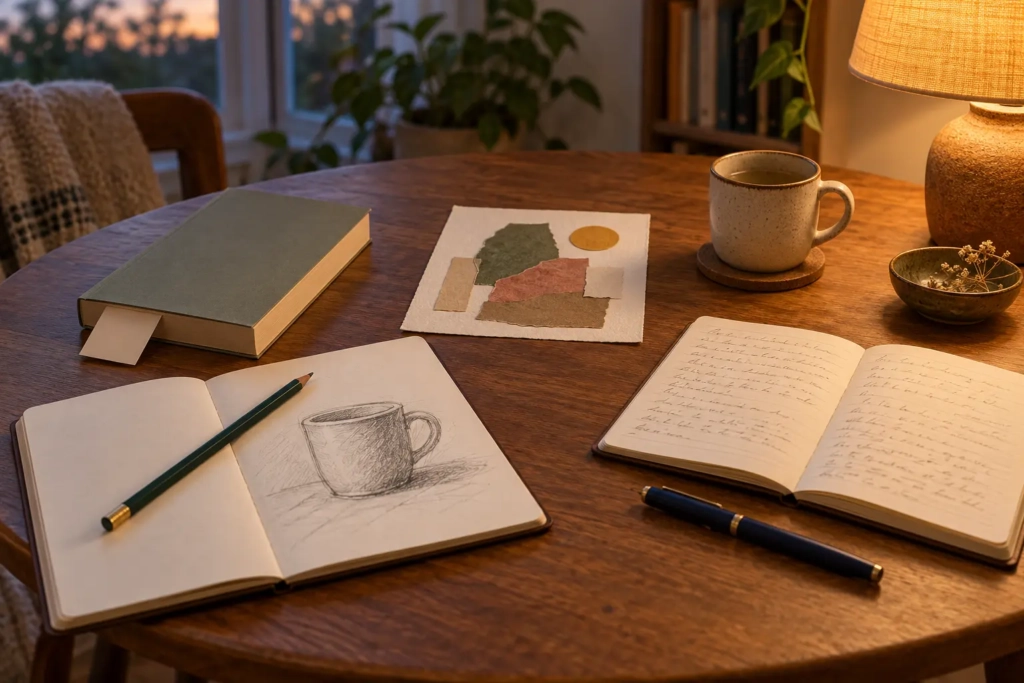
The Seven-Evening Less-Scrolling Challenge
You can sample a different activity each evening, but repeating one activity is equally valid. Adapt this plan to your supplies instead of buying a guitar or a paint set just to complete a checklist.
| Evening | Small task | Finish when… |
|---|---|---|
| 1 | Draw a mug using three values | You have light, middle, and dark areas |
| 2 | Paint a small sky, or shade another object | You have explored one transition |
| 3 | Practice two guitar chords, or repeat a hobby you enjoyed | You have completed a short, comfortable session |
| 4 | Write a memory scene | You have included three specific details |
| 5 | Prepare a familiar snack or side dish | You have noted one useful adjustment |
| 6 | Read a small section of a paper book | You have written one thought about it |
| 7 | Make a collage or return to your favorite activity | You can name what you want to try next |
At the end of each session, record only two things: Did I enjoy the activity? What would make starting easier tomorrow? Those answers are more useful than a photograph of a perfect result.
Make the Next Session Easy to Start
Put a small kit where you normally begin scrolling: a sketchbook and pencil beside the sofa, a book near your usual chair, or a writing pad on the table. Store sharp tools, paints, and other supplies appropriately, especially around children and pets.
Use your phone for preparation if you need it. Download or print a lesson, check a chord shape, or copy a recipe. Then set the device aside. The point is to create an uninterrupted activity, not to pass a test of technological purity.
If you only have ten minutes, reduce the task. Draw the handle instead of the whole mug. Write one paragraph instead of a page. Stop while the hobby still feels inviting, and leave a clear place to resume.
You do not need to announce a new identity or promise to give up scrolling forever. Tonight, choose one object, one page, or one small project. Give it a little attention and leave yourself a reason to return tomorrow.
Frequently Asked Questions
What is the easiest screen-free hobby to start at home?
Pencil drawing or handwritten creative writing requires very little preparation if you already have paper and a pencil or pen. Pick one household object to sketch, or describe a remembered scene. Collage is another accessible option when you have spare paper and glue.
Can I start a creative hobby if I am not artistic?
Yes. Begin with a practice task rather than an impressive finished piece. Looking carefully, mixing two colors, or arranging paper shapes gives you something specific to learn. Your first result does not need to resemble the examples that inspired you.
Does using an ebook make a hobby less screen-free?
An ebook can help you prepare a session. Read the relevant instructions, note the exercise on paper, and set your device aside while you practice. If you need frequent reference, a printed exercise or paper book may suit you better.
Do I need to spend money to begin?
Not necessarily. Drawing, writing, reading a book you already have, and using scrap paper can require no additional purchases. Painting and guitar need suitable equipment, so choose an activity that fits your existing supplies before buying anything new.