To read piano chord symbols, identify the root letter, the chord quality, any added number, and any bass note after a slash. C means C major; Cm means C minor; C7 and Cmaj7 name different seventh chords; C/E keeps a C-major chord but places E in the bass.
These symbols tell you the harmony, not every detail of a finished piano arrangement. You still need to decide how to distribute the notes and follow the chart’s timing. This beginner guide keeps the vocabulary small and ends with an original four-bar example you can play slowly without copying a song.
Key Takeaways
- The root names the chord; it does not always have to be the lowest note.
- C7 contains B-flat, while Cmaj7 contains B-natural.
- A slash usually specifies a bass note, as in C/E.
- Decode notes first, then add timing and a simple comfortable arrangement.
What does a chord symbol tell you?
A chord symbol is compact harmonic information. In Cmaj7, C is the root and maj7 specifies the seventh-chord quality. In C/E, the part after the slash names the bass. A symbol can be simple even when several notes are involved.
Open Music Theory’s chord-symbol chapter explains these components and notes that real charts use several shorthand conventions. You will encounter alternatives such as min for minor or a triangle for a major seventh. Check a chart’s legend when a mark is unfamiliar.
Chord symbols do not prescribe one octave, one fingering, or one accompanying rhythm. A lead sheet may provide a melody and chord symbols; a fuller arrangement writes out more of what you should play.
Berklee’s explanation of lead sheets describes that balance between essential information and room for interpretation. For now, choose one clear realization of each chord rather than searching for the only correct piano shape.
If the notes move too quickly for you to identify them, separate the task from speed. Our first C-major scale session is a useful note-finding exercise, although a scale and a chord are different patterns.
How do you read the root and chord quality?
Start with the capital letter, including any sharp or flat that belongs to it. Then read the suffix. A plain C conventionally indicates a C-major triad. Add a lowercase m and Cm becomes a C-minor triad.
| Symbol | Read it as | Basic notes |
|---|---|---|
| C | C major | C, E, G |
| Cm | C minor | C, E-flat, G |
| Am | A minor | A, C, E |
| F | F major | F, A, C |
Compare C and Cm on the keyboard. Keep C and G, then change E to E-flat. You are changing the third of the chord, not moving the whole hand indiscriminately to black keys.
The spelling of the symbol matters more than an assumption about the surrounding key. If a chart calls for a chord containing a note outside the key signature, do not silently replace it with a more familiar note.
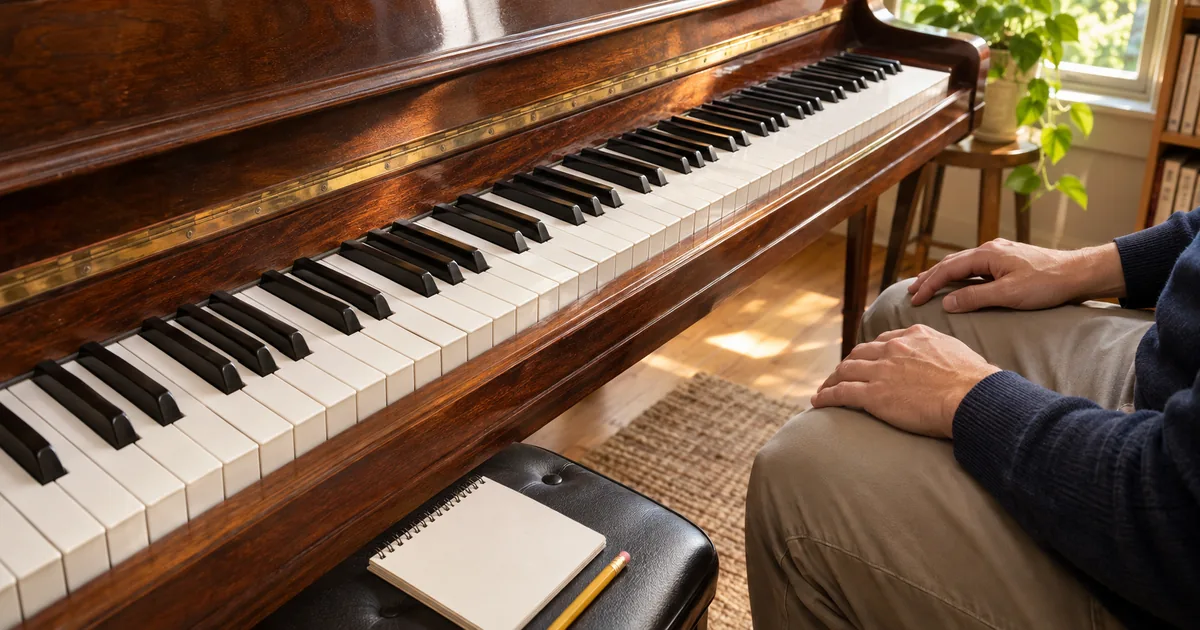
Pianote’s chord-theory lesson covers major and minor triads and inversions. Use a reference to verify unfamiliar spellings, then return to the actual symbol in front of you. An image of a hand position is not a substitute for knowing which notes it contains.
Why are C7 and Cmaj7 different?
Both contain the C-major triad C–E–G. The added note differs: C7 includes B-flat; Cmaj7 includes B-natural. The word “maj” changes the specified seventh; the number 7 does not mean seven notes.
| Symbol | Notes | What to notice |
|---|---|---|
| C7 | C, E, G, B-flat | Major triad plus a minor seventh. |
| Cmaj7 | C, E, G, B | Major triad plus a major seventh. |
| Cm7 | C, E-flat, G, B-flat | Minor triad plus a minor seventh. |
Play C7 and Cmaj7 separately at a comfortable volume. Listen to what changes when B-flat becomes B while the other notes stay the same. You do not need to assign a fixed emotion to either sound to recognize the difference.
At first, check each note without a beat. Then release and rebuild the chord. If you repeatedly return to C–E–G for both labels, you have learned the shared triad but not yet the distinction the suffix requires.
More advanced charts include extensions and alterations beyond these examples. Treat an unfamiliar symbol as a new decoding task rather than guessing that every extra number simply adds the next white key.
What does a slash chord change?
In C/E, play C-major harmony with E as the lowest note. C remains the root; E is the specified bass. This is not an instruction to play C major followed by E major.
A straightforward piano realization is E in the left hand below C–E–G in the right. Choose a comfortable register and play without forcing a stretch. The repeated E is acceptable in this basic arrangement.
Compare it with a version that has C in the bass. The chord identity remains C major, but the bottom note and spacing change the result. Slash notation gives useful information that disappears if you treat everything after the slash as optional decoration.
The bass after a slash is not always a member of the upper chord in every chart. This guide starts with C/E because the relationship is easy to inspect. If the symbol becomes more complex, use the relevant notation reference instead of assuming every slash means the same inversion pattern.
What does a complete four-bar example look like?
The following progression and rhythm are an original learning exercise, not an excerpt from a song. Use four beats per bar. On beat one, play the listed left- and right-hand notes together, hold through the bar, then release before the next chord. Start without a sustain pedal so you can hear accidental overlaps.
| Bar | Symbol | Left hand | Right hand |
|---|---|---|---|
| 1 | Cmaj7 | C below middle C | E, G, B above middle C |
| 2 | Am | A below that C | Middle C, E, A |
| 3 | F | F below that A | Middle C, F, A |
| 4 | G7 | G above that F | B below middle C, then D and F above it |
Check the combined notes
Bar one contains C–E–G–B, so it realizes Cmaj7. Bar two contains A–C–E, with A doubled. Bar three contains F–A–C, with F repeated. Bar four contains G–B–D–F, the notes of G7. The left hand supplies a note the right hand does not always contain.
These are suggested positions, not compulsory fingerings. Find the notes separately first, and keep the hands comfortable. If coordinating both hands is the obstacle, practice each part, then combine one chord before attempting the sequence.
Use a deliberate wrong-note check
Imagine the learner plays B-flat in bar one. The result fits C7 instead of the written Cmaj7. Correct B-flat to B-natural, rebuild the chord, and repeat the bar. That is a specific notation correction, not a reason to practice the whole sequence faster.
The expected result is four clearly identified harmonies placed on their first beats. It is not yet a complete song accompaniment. Our both-hands beginner exercise can help if combining the parts still demands most of your attention.
How should you practice unfamiliar symbols without guessing?
Use a small decoding routine before adding complexity. Say the root, name the chord type, list the notes, and check the bass instruction. Play only after those decisions are clear.
- Work on a pair that differs in one feature, such as C7 and Cmaj7.
- Keep a short personal note of unfamiliar suffixes and the reference used to verify them.
- Separate note accuracy from keeping the pulse.
- Add a more active accompaniment only after the simple version is dependable.
When you introduce a metronome, choose a pace that lets you prepare the next chord without rushing. Our metronome guide focuses on listening to timing rather than chasing the click.
If you are building a broader practice path, Piano Mastery is a relevant ebook in the catalog. Keep this session’s target narrow: accurately distinguish the few symbols you are currently meeting.
Conclusion
Compare C7 and Cmaj7, then play the four-bar exercise one chord at a time. Check the combined notes before adding a beat. Once the symbols are clear, use the chart’s timing and a comfortable arrangement to turn that harmonic information into music.
Frequently Asked Questions
Does a chord symbol tell me exactly which fingers to use?
No. Fingering depends on register, spacing, the preceding and following chords, and your hand. Begin with a comfortable arrangement you can release cleanly. If a position requires strain, change the spacing or seek suitable instruction rather than forcing it.
What if a chord appears above a lyric instead of a staff?
It still names the harmony, but a lyric-only chart may not specify exact rhythmic placement as clearly as a notated lead sheet. Use the arrangement’s directions or a reliable performance reference for timing. Do not assume that equal spaces between printed words mean equal numbers of beats.