Most dry lentils can go straight from sorting and rinsing to cooking; they do not need an overnight soak. Put them in water, bring the pot to a boil, then simmer gently and check the texture. The variety, packet instructions, and dish you want matter more than following one timing rule for every lentil.
Learning how to cook lentils without soaking makes them easier to use on an ordinary evening. This guide focuses on a small stovetop batch, then shows how to choose between a lentil salad and a softer soup. It also explains why a pot that needs more water is not necessarily a failed batch.
Key Takeaways
- Sort and rinse dry lentils before cooking.
- Choose whole lentils when you want distinct pieces; split lentils suit softer dishes.
- Use the packet as your starting guide and judge the finished texture by tasting.
- Cool leftovers promptly in shallow containers and refrigerate them safely.
Which lentils work for the dish you want?
A packet labeled simply “lentils” may contain whole brown or green lentils, while another contains split red lentils. Those are not interchangeable if your goal is a salad with separate, recognizable pieces. Choose the ingredient with the finished meal in mind.
Whole lentils keep their outer structure and can suit bowls, salads, and side dishes when cooked until tender. Split lentils tend to soften and break down more readily, making them useful when you want a thicker soup or a soft base. Check the packet because product names and preparation vary.
| What you want | Useful starting choice | Texture to check |
|---|---|---|
| Salad with distinct lentils | Whole brown or green lentils | Tender center, pieces still separate |
| Soft soup or puree-style dish | Split red lentils | Soft enough to blend into the dish |
| Quick addition without dry cooking | Cooked canned lentils | Already cooked; drain as the recipe directs |
Lentils.org’s cooking guide confirms that lentils can be cooked without soaking and distinguishes whole from split cooking. Use that basic distinction before worrying about a precise minute count.
If you are assembling a practical store cupboard, our pantry staples guide addresses what to keep on hand. The cooking decision here is narrower: what texture will make tonight’s meal work?
What should you do before cooking?
Tip the dry lentils onto a light plate or tray and look through them. Remove any small stones or unwanted material, then rinse the lentils in a fine-mesh sieve under running water. Choose a mesh fine enough that small split pieces will not disappear through it.
Use a saucepan with room for the lentils, water, and bubbling. An undersized pan makes stirring and checking awkward. Have extra water available so you can maintain the simmer if the pot becomes dry before the centers soften.
Read the package before adding other ingredients. The directions may specify a water ratio, lid position, or a broad cooking time for that particular product. Make those your starting instructions rather than assuming a method for split lentils will fit a whole variety.
The lentil handout shared by K-State and Montana Extension’s lentil factsheet both describe cooking without soaking. Their ratios and timings differ. Pan conditions and the intended result help explain why a useful method also needs observation, not just a timer.
How do you simmer a small batch without soaking?
Start with a manageable amount
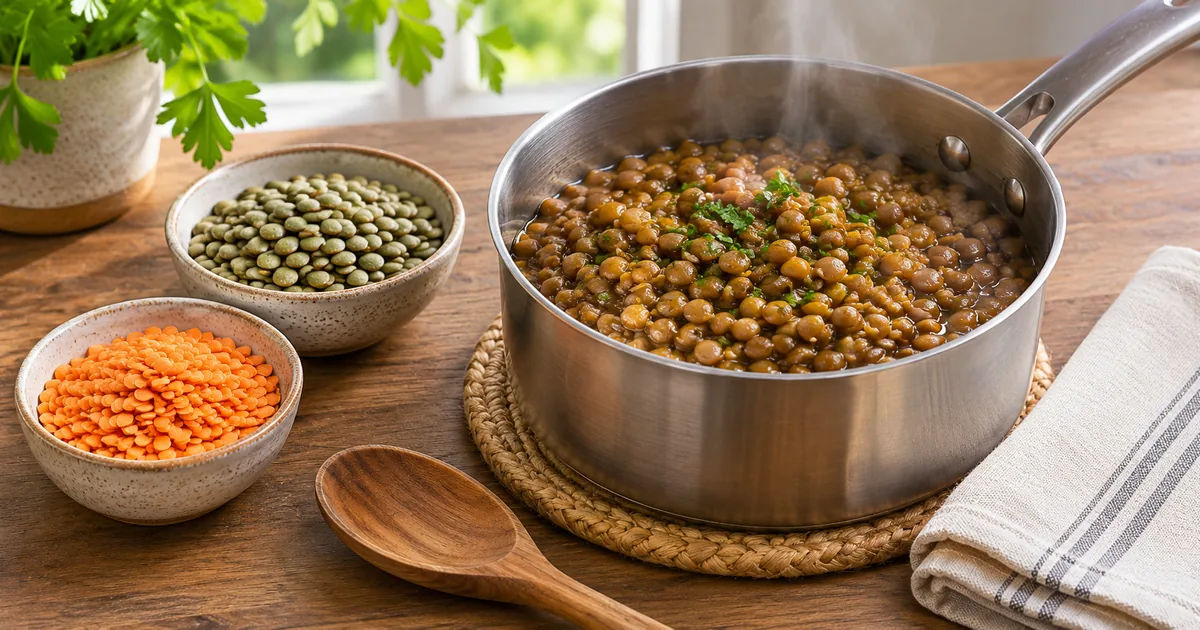
For a worked example, use half a cup of sorted, rinsed whole lentils. If the packet supplies a method, follow it. Otherwise, the three-parts-water-to-one-part-dry-lentils starting ratio in the Lentils.org guide gives you one and a half cups of water for this batch. This example is a method to adapt, not a claim that every packet behaves identically.
Put the lentils and water in the saucepan and bring them to a boil. Reduce the heat to a gentle simmer. Watch the pot rather than leaving it at a vigorous boil; keeping the cooking controlled makes it easier to monitor both water and texture.
- Set a timer to remind you to check rather than to declare the batch finished.
- Stir gently occasionally and see whether enough liquid remains.
- If the lentils are still firm and the pot is drying out, add water and continue simmering.
- When the texture suits the dish, drain excess water if the recipe calls for separate lentils.
Use time as a checkpoint
Whole lentil instructions commonly involve cooking measured in tens of minutes, but the guides above give different ranges. Split lentils can soften much sooner. Start checking according to your packet; if you have no directions, check early enough to observe the change instead of waiting for a supposed universal finish time.
Keep the heat low enough that you can maintain the pot comfortably. If you need to leave the cooking area, pause the task safely rather than relying on a timer to prevent a dry pan.
How can you tell when the lentils are ready?
Carefully remove a small sample with a clean spoon, let it cool enough to taste safely, and check several pieces. A tender surface with a hard center means the lentils need more cooking for this method. One soft lentil does not prove that the whole batch is ready.
The desired texture depends on the meal. For a salad, stop when the centers are tender and the whole lentils still hold their shape. For soup, a softer result may be useful. Decide what you need before treating every broken piece as a mistake.
If the lentils remain firm, check whether the simmer is actually continuing and whether liquid is available. Add water when needed, then reassess. Avoid covering a problem with seasoning before you know whether the texture is right.
If they have become much softer than planned, change the meal instead of trying to restore their shape. Fold them into soup or mash them into a suitable sauce. For a future salad, check earlier and choose a whole variety; split red lentils cannot be expected to behave like firm whole green ones.
Season the finished batch to taste and according to your recipe. Tasting near the end lets you judge the actual food you are serving rather than seasoning by a fixed number intended for a different batch size.
How do you turn the batch into a useful meal?
Suppose your original plan is a lunch bowl with cooked lentils, chopped cucumber, roasted carrots, and a lemon dressing. The lentils need to be tender but distinct. Cook them separately, drain any excess water, and combine them with the other prepared ingredients when ready to assemble.
Now suppose you open the cupboard and find only split red lentils. Choose a soup instead: cook them with the liquid and ingredients specified by a suitable soup recipe, allowing the softer texture to become part of the dish. The decision is to change the format, not to force an unsuitable variety into the original salad.
These are illustrative meal plans, not recipes with tested yields or nutrition values. Add portions and ingredients that suit your household, and use a complete recipe when you need exact seasoning, cooking order, or nutritional information.
If you are reducing a larger recipe, our recipe-scaling guide helps with the quantities. Do not substitute the same measured amount of dry lentils for canned lentils: one is uncooked and the other already contains absorbed water.
For a work lunch, pack any dressing and crisp ingredients separately when that suits the meal, and keep the food properly chilled. Texture planning should make lunch more enjoyable without compromising storage.
How should you cool, store and reuse leftovers?
Do not leave a large pot on the counter until it becomes completely cold. Divide leftovers into shallow containers and refrigerate promptly. The USDA’s leftover guidance calls for refrigeration within two hours, or within one hour when the surrounding temperature exceeds 90°F/32°C.
Keep the refrigerator at 40°F/4°C or below and use refrigerated leftovers within three to four days, or freeze them. Label the container with the cooking date. A vague memory of “earlier this week” is a poor storage system when several meals are in the fridge.
Portion for the next use: a small container for a bowl, or a soup portion you can reheat as a meal. Our guide to freezing soup in portions covers the second option. Freezing does not reverse unsafe time already spent at room temperature.
Plan the reuse before cooking a much larger batch. If you cannot name a near-term meal or make freezer space, a smaller batch may be the more practical choice. Cooking without soaking is convenient partly because you can start a fresh manageable amount when you need it.
Conclusion
Check your lentil packet and choose tonight’s texture first: separate pieces for a bowl or a softer result for soup. Sort, rinse, simmer, and taste rather than relying on one universal timing rule. Cook a small batch, make one useful meal from it, and put the remaining portions away promptly.
FAQ
Can I use the cooking water in the finished dish?
If the recipe is a soup or another liquid-based dish, its method may keep the cooking liquid. For a salad or separate side, draining excess liquid is often more practical. Follow the recipe’s intended consistency instead of assuming that every batch must either absorb all its water or be drained.
Can I replace this stovetop method with a pressure-cooker method?
Use directions written for your appliance and the specific lentils instead of transferring the stovetop timing. Pressure cooking changes the method, and the equipment has its own liquid and fill requirements. Consult the appliance manual and an appropriate recipe; this guide does not provide pressure-cooker settings.