To scale a recipe, divide the number of portions you want by the number the recipe makes. Multiply the listed ingredient quantities by that factor. Then check the method separately: equipment capacity, food depth, seasoning, and cooking time do not become correct merely because the arithmetic is correct.
This guide explains the calculation with an original four-to-three-portion couscous and chickpea salad. It also shows where a cooked dish or a bake needs extra judgement. Use a tested recipe’s specific instructions when available, particularly when the method depends on precise ratios or specialized equipment.
Key Takeaways
- Desired portions divided by original portions gives the scaling factor.
- Keep dry, cooked, drained, weight, and volume measurements distinct.
- Write a complete revised list before preparing ingredients.
- Check equipment and cooking separately from the ingredient calculation.
How do you calculate the recipe scaling factor?
Start with the stated yield. If the original makes four portions and you want three, the calculation is 3 ÷ 4 = 0.75. Every measured ingredient begins at three quarters of its listed amount. If you want six portions instead, use 6 ÷ 4 = 1.5.
Write the factor at the top of your working note and apply the same factor throughout the list. Mixing mental calculations makes it easy to halve one ingredient, leave another unchanged, and accidentally double a third. A written pass takes less effort than repairing a partly assembled dish.
Canada’s Food Guide describes doubling and halving ingredient quantities while treating taste and cooking time as separate considerations. The same arithmetic extends to a factor such as 0.75, provided you preserve the meaning of the original measurements.
Check what the yield represents. Four starter portions are not necessarily four main meals. Scaling preserves the original recipe’s portion concept; it does not decide whether that amount suits your appetite or the rest of the meal.
If the original yield is unknown, use another verified basis, such as a stated dough weight or batch count. Clarify this before calculating portions.
How do you adjust every ingredient consistently?
Keep the units while multiplying. For example, 240 grams × 0.75 = 180 grams. For 2 teaspoons, the same factor gives 1.5 teaspoons. You are changing the quantity, not converting grams into milliliters or assuming all ingredients have the same density.
Read the ingredient description before measuring. A weight of dry grain is different from that grain’s cooked weight. Canned chickpeas measured after draining differ from the can’s total contents. If the original specifies drained or prepared ingredients, retain that condition in your revised list.
Resolve awkward amounts before starting
A factor can produce half a small vegetable or part of an egg. In a flexible salad, weighing the prepared vegetable can be more practical than guessing a fraction by eye. With baking, fractional eggs may need a measured approach. King Arthur Baking’s recipe-reduction guide discusses handling reduced quantities alongside the pan and bake.
Review optional additions too. Record any garnish or seasoning left to taste so a missing calculation is not mistaken for an intentional decision.
Include optional additions in the review. You might leave a garnish to taste, but note that choice explicitly. Otherwise, a missing calculation can look like an intentional decision when you return to the recipe.
What does a four-to-three-portion conversion look like?
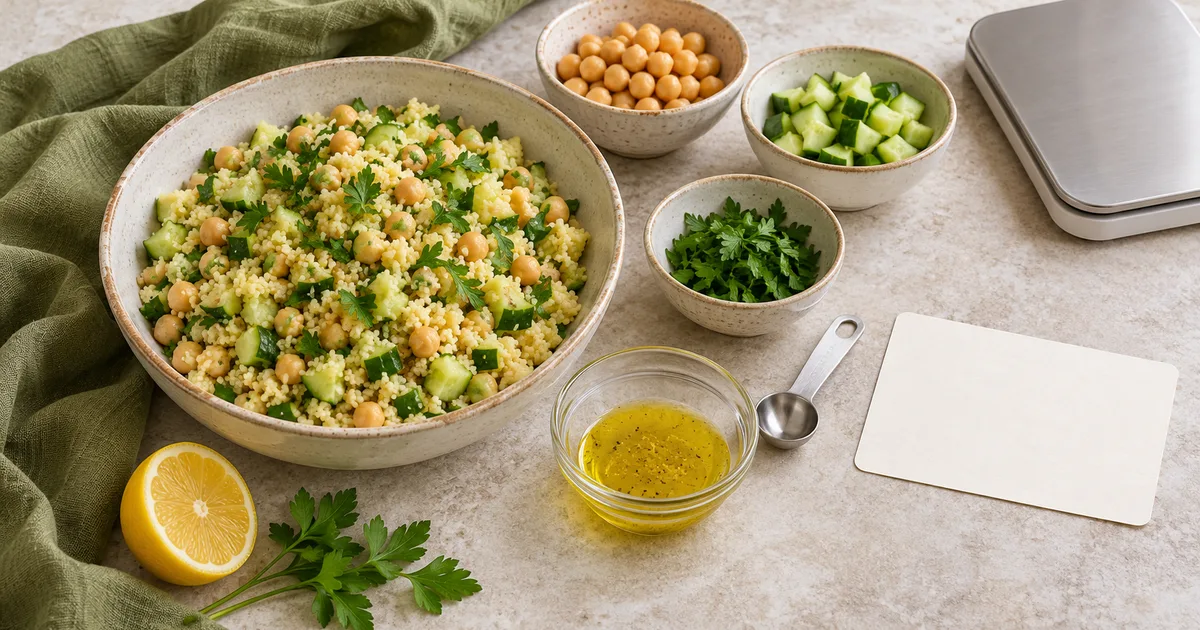
Here is an original planning example for a simple couscous and ready-cooked chickpea salad. It is an illustrative assembly, not a nutrition-analyzed recipe. The original quantities are chosen for four moderate portions; the revised list uses a factor of 0.75.
| Ingredient | Four-portion base | Multiply by 0.75 | Three-portion amount |
|---|---|---|---|
| Dry couscous | 240 g | 240 × 0.75 | 180 g |
| Ready-cooked chickpeas, drained | 400 g | 400 × 0.75 | 300 g |
| Prepared cucumber | 200 g | 200 × 0.75 | 150 g |
| Olive oil | 40 ml | 40 × 0.75 | 30 ml |
| Lemon juice | 40 ml | 40 × 0.75 | 30 ml |
| Chopped parsley | 20 g | 20 × 0.75 | 15 g |
Prepare the 180 grams of dry couscous using the instructions and liquid ratio for the actual product. Different products can have different preparation methods; the salad table does not replace that instruction. Use ready-cooked chickpeas, not dried ones substituted without cooking.
Combine the prepared couscous with the drained chickpeas, cucumber, and parsley when the grain is at an appropriate temperature for the salad. Mix the oil and lemon juice separately. Add some dressing, toss, and assess before adding the remainder. Season according to taste and the ingredients you used.
Divide the mixed salad into three portions. If your household wants larger meals, add appropriate accompaniments or choose a higher yield next time rather than calling these portions universally sufficient.
Follow the decision through to the result
Suppose the salad seems too sharply dressed after you add most of the mixture. Stop adding it. Your note should distinguish the calculated dressing from the amount actually used. The arithmetic was correct; your taste preference changed the final assembly.
Record that the three-portion version used 180 grams of dry couscous and only part of the dressing. Next time, reproduce that choice deliberately. For other meal ideas, The High Protein Recipe is a related BestDigiBooks cookbook; follow each recipe’s own quantities and method.
What changes when the recipe needs heat?
Scale ingredient amounts first, then reassess how the food will cook. A larger quantity in the same pan may form a deeper layer or crowd the surface. Dividing it between suitable pans or cooking in batches can be more practical than forcing it into the original vessel.
Do not multiply the cooking time by the serving factor. A double batch does not automatically need twice as long, and a half batch does not automatically finish in half the time. The food’s dimensions, depth, equipment, and cooking method still matter.
Use the original recipe’s appropriate doneness checks rather than the clock alone. When cooking foods that require a safe internal temperature, follow reliable guidance for that food and use the appropriate thermometer check. This scaling guide does not replace those requirements.
Our air-fryer chicken guide explains why even size and spacing matter for that specific dish. Increasing a batch does not mean filling every available gap in an air-fryer basket. Keep within the appliance’s instructions and leave room for the method to work.
Seasoning also deserves a deliberate final check when it is safe to taste. The Canadian guide notes that spices do not always need a straight doubling. Do not extend that flexibility to structural baking ingredients without recipe-specific guidance.
Why does baking need a separate pan check?
A pan changes the shape and depth of batter. Reducing the ingredients while keeping a very large pan can produce a much shallower bake; adding more batter to a smaller pan can risk overflow and uneven results. Pan capacity, shape, and material all deserve attention.
King Arthur Baking’s pan-size guide explains why similar-looking pans are not necessarily equivalent. Comparing one length or diameter is insufficient. For straightforward shapes at a comparable depth, base area can help assess a possible substitution, but it is not a universal recipe-conversion rule.
Consider an original 20-by-20-centimeter square pan. Its base area is 400 square centimeters. At a 0.75 recipe factor, a comparable-depth starting target would be 300 square centimeters. A 15-by-20-centimeter rectangle has that area, but its depth, material, and the specific recipe still need checking.
This geometry example is not a tested cake substitution. Some bakes require particular pans or cooling arrangements. An established batch may be more dependable than an improvised setup.
Keep the original baking temperature unless reliable recipe-specific instructions direct otherwise. Watch the appropriate doneness indicators and record what happened; do not invent a temperature adjustment merely because the ingredient quantity changed.
How should you record the result for next time?
Save the original recipe separately from your adapted version. Label the new yield, factor, ingredient amounts, pan or equipment, and meaningful observations. That makes it possible to understand whether a different result came from scaling or another change.
Keep three short notes: what you calculated, what you actually used, and what you would change. In the salad example, those are the 0.75 factor, the weighed ingredients plus partial dressing, and the preferred dressing quantity for the next attempt.
Change one additional variable at a time where practical. If you scale, substitute ingredients, change equipment, and alter seasoning together, it becomes harder to identify the source of a problem. Our weeknight dinner guide can help you choose another suitable dish when the original is awkward to adapt.
Did the amount match the intended meal? A useful adapted recipe fits your household and remains clear enough for someone else to follow.
Conclusion
Choose a familiar recipe, write its original yield, and calculate desired portions divided by original portions. Rewrite every quantity before you start. Then check the method, equipment, and finished result separately, keeping a short note of any intentional adjustments.
Frequently Asked Questions
Can I use the same factor to change cups into grams?
No. Scaling and unit conversion are different operations. Multiply quantities within their original units, then use a reliable ingredient-specific conversion if you need a different unit. A cup of flour and a cup of oil do not have the same weight.
Does this method apply to home canning or preservation recipes?
Do not treat this general cooking method as permission to alter tested preservation procedures. Batch sizes, ingredient proportions, equipment, and processing instructions can be safety-critical. Use the exact guidance from a reliable tested preservation recipe, including any limits on scaling.