Ebooks promise a simple idea: an entire book delivered instantly to a device you already own. But are they actually worth buying, or are printed books still the better choice?
The honest answer is that neither format is universally superior. A beautifully printed book can offer a satisfying physical experience that a screen cannot reproduce. An ebook, however, can make reading more accessible, portable, searchable, affordable, and easier to fit into everyday life.
Its real value is not just that it replaces paper. It changes what you can do with a book and how quickly you can put its ideas to use.
If you are deciding whether digital books deserve a place in your reading routine, here are 11 practical benefits that may matter more than you expect.
The Short Answer: Are Ebooks Worth It?
Ebooks are usually worth considering if you value immediate access, portability, adjustable text, searchable content, convenient note-taking, and the ability to read across different devices.
They can be especially useful for:
- busy readers with limited time;
- travelers and commuters;
- students and lifelong learners;
- people with limited storage space;
- readers who need larger or adjustable text;
- anyone using books to solve a specific problem or develop a practical skill.
However, ebooks are not automatically better or cheaper in every situation. Their value depends on the quality of the book, the price, the file format, the reading device, and how you prefer to learn.
The most useful question is not simply, “Are ebooks good?”
It is:
Will this ebook make it easier for me to read, learn, and act on the information?
1. You Can Start Reading Immediately
One of the clearest benefits of an ebook is immediate access.
There is no trip to a bookstore, shipping delay, missed delivery, or need to wait for an item to return to stock. Once the purchase and download are complete, you can usually begin reading within minutes.
This convenience becomes particularly valuable when the subject feels urgent or timely. A new parent may want practical guidance before another difficult evening. Someone preparing for an interview may need help building confidence that weekend. A reader starting a fitness or nutrition plan may want recipes and planning tools before the beginning of the week.
Instant access shortens the distance between intention and action.
That does not mean every ebook will produce an immediate result. Reading still takes time, and applying the material requires effort. But removing the waiting period can help you use the motivation you have now instead of hoping it remains several days later.
2. An Entire Library Can Travel With You
A single phone, tablet, laptop, or e-reader can hold far more books than most people could comfortably carry.
For travelers, commuters, students, and people who move frequently, this changes the practical experience of owning a library. You do not need to decide which heavy book deserves space in your bag. You can keep a business guide, a novel, a recipe collection, and a personal-development workbook available on the same device.
This flexibility also makes it easier to match your reading to the moment.
You might study during a train journey, review a recipe while shopping, revisit an exercise during a lunch break, or read a few pages before an appointment. The book is available when the opportunity appears.
Portability is not only about travel. It is also about reducing friction. When useful information is already with you, returning to it becomes easier.

3. Ebooks Can Fit Into Small Pockets of Time
Many people believe they do not have enough time to read because they imagine reading as a long, uninterrupted activity.
In reality, meaningful reading can happen in short sessions.
Ten minutes before work, fifteen minutes on public transportation, or a quiet moment before bed can add up over a week. Because an ebook may already be available on your phone or tablet, you can continue without carrying an additional object or trying to remember where you left it.
Some reading applications also synchronize your position across devices. Depending on the platform and file format, you may be able to read on a tablet at home and continue from the same place on your phone later.
This is especially useful for practical nonfiction. A short section, one exercise, or a single recipe may be enough to create progress during a busy day.
The convenience will not create a reading habit by itself, but it can make that habit easier to maintain.
4. You Can Adjust the Reading Experience
A printed page has a fixed design. An ebook may offer more flexibility.
Depending on the device, application, and ebook format, readers may be able to change:
- font size;
- typeface;
- line spacing;
- margins;
- screen brightness;
- background color;
- portrait or landscape orientation.
These adjustments can make reading more comfortable for people who find small print difficult or prefer a less crowded page. Some readers may benefit from dark mode in low-light environments, while others may prefer a warm background rather than a bright white screen.
The available features vary. A reflowable EPUB file usually offers more display flexibility than a fixed-layout PDF, for example. Before buying, check the format and confirm that it works with the device or application you plan to use.
A comfortable reading experience matters because even excellent content loses value if the format makes you avoid opening the book.
5. Finding Important Information Is Faster
Printed books encourage careful browsing, but they can be slow to search when you need one specific detail.
Many ebook readers allow you to search for a word or phrase and move directly to relevant sections. This is particularly valuable for reference books, instructional guides, textbooks, recipe collections, and professional resources.
Imagine trying to find:
- a particular exercise in a fitness guide;
- one ingredient in a recipe collection;
- advice about a specific dating situation;
- a photography setting you previously studied;
- a business term you need to review;
- a passage you remember but did not bookmark.
Search turns the book into a more responsive resource.
Instead of relying only on memory or scanning the index, you can often locate the relevant material within seconds. For readers who return to the same ebook repeatedly, this feature may become one of the format’s greatest advantages.
6. Highlighting and Note-Taking Can Be More Organized
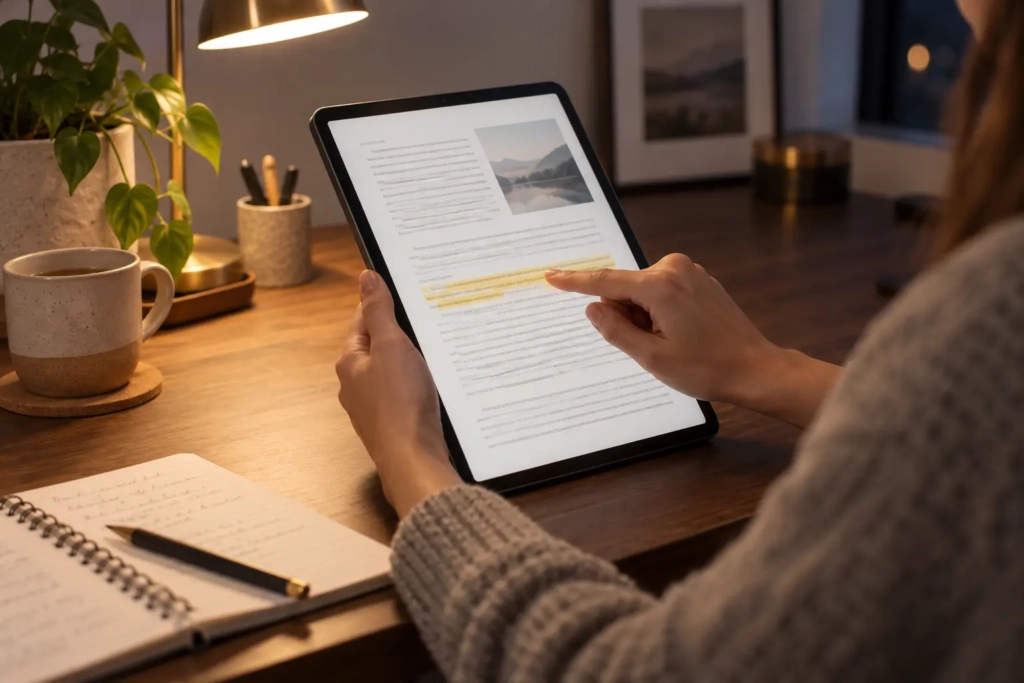
Reading becomes more useful when you interact with the material.
Many digital reading tools allow you to highlight passages, add notes, create bookmarks, or copy short excerpts for personal study, subject to the platform’s features and usage restrictions.
Digital notes can be easier to organize than marks scattered across several physical books. In some applications, highlights can be reviewed together, searched, or synchronized across compatible devices.
This is particularly helpful when reading for a practical goal.
Instead of highlighting everything that sounds interesting, you can mark information under simple categories:
- understand;
- try;
- discuss;
- research;
- review later.
You might also write one action beside each important section. A business idea becomes a small experiment. A nutrition lesson becomes a meal-planning decision. A reflection question becomes a journal entry.
The technology is useful, but the method matters more. Highlighting dozens of paragraphs without returning to them creates the appearance of learning. Selecting a few valuable ideas and applying them creates progress.
7. Digital Reading Can Offer Greater Privacy
Some books address subjects people may not feel comfortable displaying publicly.
A reader may want help with divorce, dating confidence, intimacy, parenting difficulties, emotional wellbeing, finances, or a personal health concern. Carrying a physical book with a highly visible title can feel uncomfortable at home, at work, or on public transportation.
An ebook allows the cover and title to remain on the device rather than being visible to everyone nearby.
This privacy can make it easier for readers to explore sensitive subjects without feeling observed or judged. It may also help people seek educational information earlier instead of avoiding a useful resource because of embarrassment.
Digital privacy is not absolute, however. Devices, accounts, cloud libraries, and shared payment methods can leave records. If confidentiality matters, review your device settings, account access, notification previews, and purchase history.
The benefit is discretion, not invisibility.
8. Ebooks Require Almost No Physical Storage
A growing collection of printed books needs shelves, boxes, cleaning, and space.
For readers living in a small apartment, moving regularly, sharing a home, or trying to reduce clutter, digital books offer a practical alternative. Hundreds of titles can be stored without filling another room or increasing the weight of the next move.
This does not mean physical books are clutter. A personal library can be beautiful, meaningful, and deeply connected to memory. Many readers enjoy seeing their books and returning to familiar pages.
The advantage of ebooks is choice.
You can reserve physical space for editions you truly want to own as objects—favorite novels, art books, gifts, or collectible publications—while using ebooks for practical guides, temporary interests, travel reading, and frequently searched references.
A mixed library is often more useful than treating the two formats as competitors.
9. Many Ebooks Can Be Budget-Friendly
Ebooks do not require printing, binding, physical warehousing, or conventional delivery to the reader. This can allow some digital titles to be sold at attractive prices.
However, an ebook is not automatically cheaper than its printed equivalent. Pricing varies by publisher, retailer, licensing model, demand, and region. Major new releases may have only a small price difference, while independent guides or promotional titles may offer more noticeable savings.
To judge value fairly, look beyond price alone.
Ask what the ebook includes:
- Is the information relevant to your goal?
- Is it organized clearly?
- Does it contain exercises, examples, checklists, recipes, or templates?
- Will you use it more than once?
- Does it save you time or help you avoid a costly mistake?
- Is the file compatible with your preferred device?
A low-priced ebook you never use is not a bargain. A carefully chosen guide that supports a meaningful decision may offer excellent value even if it is not the cheapest option available.
10. Ebooks Can Make Practical Learning Easier
A digital book can sit beside the task it is helping you complete.
You can keep a recipe open in the kitchen, review an exercise plan at home, follow a software tutorial on a second screen, or complete a worksheet while reading the instructions.
This connection between learning and action is especially valuable for goal-focused books. Instead of reading an entire guide and trying to remember everything later, you can move between explanation and implementation.
A useful approach is to read in short action cycles:
- Read one relevant section.
- Identify its main idea.
- Choose one action.
- Test it in real life.
- Record what happened.
- Return to the book for the next step.
This method turns reading into a working process rather than a passive activity.
BestDigiBooks focuses on practical digital guides across areas such as personal development, relationships, parenting, fitness, nutrition, business, beauty, and everyday skills. When choosing from any category, look for the book that helps you take a specific next step—not merely the one with the broadest promise.
11. Digital Libraries Make It Easier to Read With Purpose
A physical bookstore is wonderful for discovery, but an organized digital collection can make goal-based reading more direct.
You can search by subject, compare descriptions, examine contents, and choose a guide that addresses a particular problem. Once purchased, relevant resources can be grouped by goal rather than stored wherever shelf space is available.
For example, you might create digital collections for:
- health and fitness;
- professional development;
- relationships and communication;
- parenting;
- personal finance;
- creative skills;
- books to apply this month;
- reference books to revisit.
This organization can prevent useful information from disappearing into a forgotten folder.
The key is not to build the largest possible digital library. Collecting ebooks can become another form of procrastination if purchasing replaces reading and application.
A small, intentional collection is often more valuable than hundreds of unread files.
Are Ebooks Better for the Environment?
The environmental comparison between ebooks and printed books is more complicated than it first appears.
Printed books require paper, ink, manufacturing, packaging, transportation, and physical storage. Digital reading avoids producing and shipping a separate physical copy for each purchase.
Digital devices, however, also have environmental costs. They require raw materials, manufacturing, electricity, data infrastructure, and eventual electronic-waste management.
The practical balance depends on factors such as:
- whether you already own the device;
- how long you keep it;
- how many books you read digitally;
- whether printed books are purchased new, borrowed, shared, or bought secondhand;
- the energy and production systems involved.
If you already own a suitable phone, tablet, computer, or e-reader and use it for many books over several years, digital reading may reduce the need for additional physical production. But it is better to view environmental impact as a reason to consume thoughtfully—not as a universal claim that one format is always greener.
What Are the Disadvantages of Ebooks?
A fair decision also requires understanding the limitations.
Screen fatigue
Reading on a bright phone or tablet can become uncomfortable, particularly after a day spent working on screens. An e-ink reader or carefully adjusted display may help, but preferences vary.
Battery dependence
A printed book never needs charging. Digital reading requires a functioning device and enough battery power.
Device compatibility
Not every file works equally well on every application or device. PDFs may be difficult to read on small screens, while protected formats may be tied to a particular platform.
Less physical satisfaction
Some readers remember information better when they can physically move through pages. Others simply enjoy the weight, texture, smell, and visual presence of a printed book.
Ownership restrictions
Depending on the retailer and format, purchasing an ebook may provide a license to access the content rather than unrestricted ownership of a file. Copying, sharing, lending, printing, and transferring may be limited.
Distractions
A phone or tablet also contains messages, social media, email, and entertainment. Notifications can interrupt concentration unless they are silenced.
These disadvantages do not make ebooks a poor choice. They help you decide which device, format, and reading environment will work best for you.
Ebook vs Printed Book: Which Should You Choose?
Choose an ebook when you prioritize:
- immediate access;
- easy portability;
- adjustable text;
- searchable content;
- digital highlights;
- discreet reading;
- reduced physical storage;
- convenient access across compatible devices.
Choose a printed book when you prioritize:
- a completely screen-free experience;
- physical ownership and display;
- unrestricted page browsing;
- collecting, gifting, or lending;
- the sensory experience of paper;
- reading without batteries or devices.
Choose both when different books serve different purposes.
You might buy a printed edition of a favorite novel while keeping practical reference guides digitally. You might read an ebook while traveling and purchase a physical edition later if it becomes personally important.
The format should serve the reading experience—not become a rule you feel obligated to follow.
How to Decide Whether an Ebook Is Worth Buying
Before purchasing, use this short checklist:
- Purpose: What do I want to learn, solve, or change?
- Relevance: Does this ebook directly address that goal?
- Depth: Is it appropriate for my current level?
- Practicality: Does it provide usable guidance rather than vague inspiration?
- Format: Will the file work comfortably on my device?
- Time: Can I realistically read and apply it?
- Price: Is the value reasonable for the content offered?
- Credibility: Are the claims responsible and believable?
- Reusability: Will I return to this book after the first reading?
- Action: Do I know what I will do with the information?
If you can answer these questions confidently, the ebook is more likely to be a useful purchase.
Final Verdict: Are Ebooks Worth the Money?
For many readers, yes—ebooks can be an excellent investment.
Their strongest advantage is not simply convenience. It is the combination of immediate access, portability, flexible reading settings, fast search, organized notes, privacy, and practical usability.
They are particularly worthwhile when you choose them with a clear purpose. A relevant ebook that you read and apply is worth far more than an impressive digital collection you rarely open.
At the same time, ebooks do not need to replace printed books. Each format offers a different experience, and many readers benefit from using both.
If you are looking for practical digital guides designed around real-life goals, explore the latest selections at BestDigiBooks. Choose one subject that matters now, find a guide suited to your level, and turn its most useful idea into action.
The value of an ebook is not measured by the number of files on your device.
It is measured by what the right book helps you understand, decide, or do.
Frequently Asked Questions
Are ebooks worth buying?
Ebooks can be worth buying when you value instant delivery, portability, searchable text, adjustable display settings, and convenient access. Their value ultimately depends on the quality and relevance of the content.
Are ebooks cheaper than printed books?
Ebooks are often competitively priced, but they are not always cheaper. Prices vary by publisher, retailer, region, licensing model, and title. Compare the content, format, and practical value rather than relying only on the price difference.
Is reading an ebook as effective as reading a printed book?
Both formats can support effective reading. The better option depends on the reader, the material, the device, and the level of distraction. Active reading—taking notes, reviewing ideas, and applying information—usually matters more than the format alone.
What device do I need to read an ebook?
Many ebooks can be read on a smartphone, tablet, computer, or dedicated e-reader. Always check the file format and compatibility information before purchasing.
What is the best ebook format?
EPUB is often preferred for flexible, reflowable reading because the text can adapt to different screen sizes. PDF preserves a fixed page design and may work better for visually structured guides, worksheets, or recipe books. The best format depends on the content and your device.
Can I read an ebook without internet access?
Many ebooks can be read offline after they have been downloaded to a compatible device or application. However, the initial download, account verification, or synchronization may require an internet connection.
Do I own an ebook after purchasing it?
This depends on the retailer, file, and licensing terms. Some purchases provide a downloadable file, while others provide licensed access through a specific platform. Review the retailer’s terms and any usage restrictions before purchasing.
Are ebooks good for studying?
Ebooks can be helpful for studying because many reading tools support search, highlighting, bookmarks, adjustable text, and digital notes. The available features depend on the ebook format and reading application.
Can ebooks replace printed books?
They can replace printed books for some readers and purposes, but they do not have to. Many people use ebooks for convenience and practical reference while continuing to buy printed editions for collecting, gifting, or screen-free reading.