Dramatic irony occurs when the audience knows something important that a character does not, and that knowledge changes how we understand the character’s words or actions. The essential feature is a meaningful knowledge gap. A surprising ending, an unlucky event, or a suspicious clue does not automatically create it.
You can recognize the device without memorizing famous plot spoilers. This guide uses an original, low-stakes scene to show exactly when the gap opens and closes, how it differs from other types of irony, and why knowing more can make a scene more involving.
Key Takeaways
- Identify a specific fact the audience knows and a character lacks.
- Separate established knowledge from a reader’s prediction or suspicion.
- Notice how the gap changes the meaning or feeling of the scene.
- Discuss the effect without revealing the hidden fact to someone still reading.
What makes a scene an example of dramatic irony?
Imagine reading a scene in which someone confidently makes a decision. If you already know a fact that undermines their confidence, the action can carry a second meaning. The character experiences one situation while you understand a different or fuller one.
LitCharts defines dramatic irony around audience knowledge that a character lacks. The gap must matter to the scene. Knowing the color of an unseen chair adds little unless that information changes how we interpret what the character does.
Ask who knows which fact
Name the audience’s information in one sentence, then name the character’s understanding in another. For example: ‘We know the invitation is genuine; she believes it is a prank.’ The difference is clear enough to examine without declaring every detail in the story ironic.
Keep the gap local when necessary. One character may lack a fact that several others know. The audience need not be wiser than everyone in the story, and the same gap need not last from the opening page to the ending.
How is dramatic irony different from other kinds of irony?
Literary terms are more useful when they identify different relationships. Dramatic irony concerns knowledge. Verbal irony concerns a difference between what is said and what is meant. Situational irony concerns an outcome that meaningfully cuts against an expectation.
Oregon State University’s literary guide discusses these three forms and shows that they can interact. One scene can contain more than one kind, so you do not always have to choose a single label.
| Device | Question to ask | Original miniature example |
|---|---|---|
| Dramatic irony | What relevant fact do we know that the character lacks? | We see friends hide a birthday cake; the guest thinks everyone forgot. |
| Verbal irony | Does the speaker mean something different from the literal words? | After a badly organized rehearsal, someone says, ‘That was wonderfully coordinated.’ |
| Situational irony | Does the outcome significantly reverse a relevant expectation? | A meticulously planned quiet reading retreat becomes the venue for an unplanned noisy celebration. |
Context determines whether the verbal remark is ironic; the same words could be sincere in another scene. Likewise, an unexpected result needs a relevant contrast to be more than random bad luck.
For the separate difference between misleading clues and a later reversal, read red herring versus plot twist. Those ideas concern how readers interpret a mystery, while dramatic irony asks what readers and characters know at a particular moment.
What does one original scene show step by step?
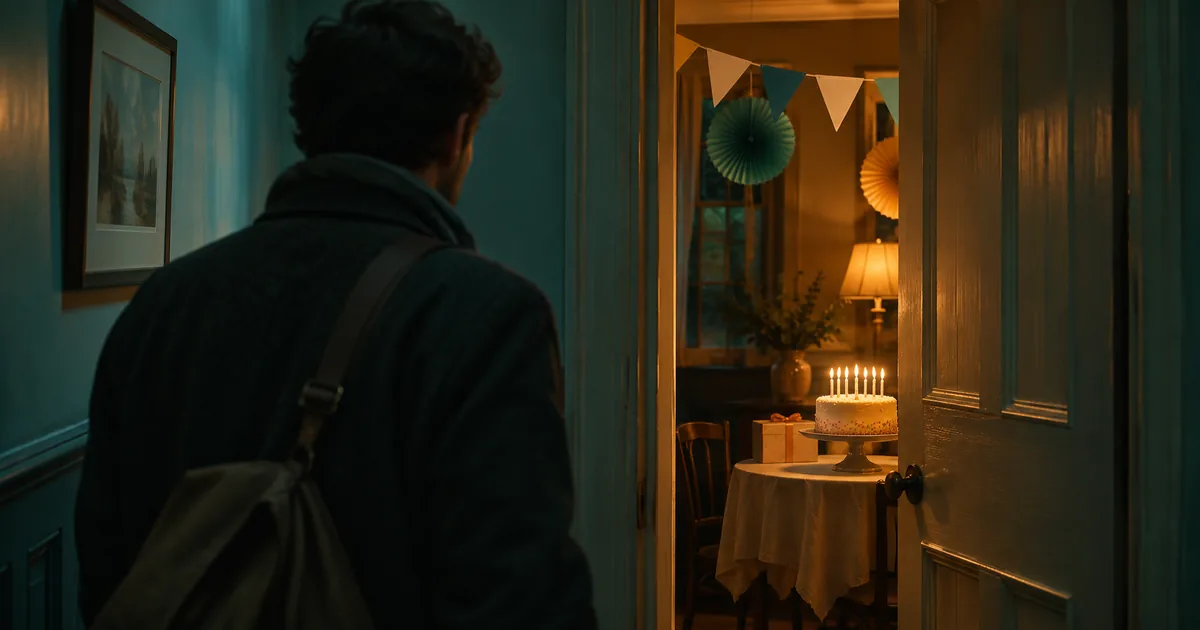
Here is an invented example with no connection to a published novel. Mara is arriving at a friend’s house after work. Before she enters, the narration shows Theo placing a birthday cake in the dining room while several friends hide nearby.
Mara waits in the hallway. She hears Theo say, ‘We have nothing planned tonight,’ and decides everyone has forgotten her birthday. The reader knows about the cake and gathering; Mara does not. Her disappointed response means something different to us because we understand the arrangement.
| Moment | Reader’s knowledge | Mara’s knowledge | Effect |
|---|---|---|---|
| Before the preparation is shown | No confirmed party information | No confirmed party information | No established gap yet |
| Theo hides the cake | A surprise is being prepared | She has not seen the preparations | The knowledge gap opens |
| Mara hears the remark | Theo is concealing the celebration | She thinks nothing is planned | Her disappointment gains an additional meaning |
| The dining-room door opens | The party is revealed | She sees the cake and guests | This particular gap closes |
Change one detail to test the label
Now imagine the narration never shows the preparations. We arrive with Mara, hear the same remark, and share her disappointment. When the door opens, the party surprises us too. The outcome is similar, but the earlier hallway scene no longer gives us the same knowledge advantage.
If we merely suspect a party because Theo seems evasive, we should describe that suspicion accurately. A possible interpretation is weaker than an established fact. This distinction keeps the term precise instead of turning every correctly guessed twist into dramatic irony.
The example also shows that the important question is not ‘Did I enjoy the reveal?’ It is ‘What did I know before the reveal, and how did that change the preceding scene?’
Why can knowing more increase suspense instead of reducing it?
A reader who knows a secret may still lack the outcome. In the party example, we know there is a cake but not whether Mara will leave before the door opens, confront Theo, or accidentally find the guests. The uncertainty shifts from what exists to what will happen around it.
That is why dramatic irony can create anticipation rather than spoil all interest. We watch ordinary actions for consequences the character cannot yet foresee. A short delay, a misunderstood sentence, or an interrupted conversation can acquire extra weight.
Scribbr’s dramatic-irony guide also discusses suspense, humor, and differences in understanding. These are possible effects, not requirements that every reader must react in the same way.
The same knowledge structure can support sympathy or frustration. We might wish Mara could see what we see, or recognize why she reaches the wrong conclusion. A character’s mistaken judgment can remain understandable when the information available to that character is limited.
Notice the difference between an author withholding everything and an author letting us know more. Both can build suspense, but they ask different questions of the reader. Knowing about a problem does not tell us whether it will be resolved.
How can you identify it without assuming a twist?
Pause at the scene itself rather than reasoning backward from an ending you have already read. List only information established by that point. A later revelation may change your interpretation, but it cannot retroactively make an earlier first-time reader know something they had not been told.
- Name the exact fact the text has established for the audience.
- Identify the character who lacks or misunderstands it.
- Point to the words or action affected by that difference.
- Describe the effect: anticipation, humor, sympathy, tension, or another response.
- Check whether the gap remains open or closes within the scene.
Also consider how trustworthy the information is. A narrator’s claim may be uncertain or misleading. Our guide to unreliable narrators helps distinguish a presented account from facts the story gives you good reason to treat as established.
On a reread, your knowledge from the ending can create a new experience of earlier scenes. Say explicitly that you are discussing a rereading effect. This avoids confusing what a first-time audience knows with what returning readers bring to the page.
How should you discuss dramatic irony without spoilers?
Describe the relationship and its effect before revealing the information itself. You might say, ‘The scene creates tension by giving readers information that one character lacks.’ That explains the technique without naming the secret.
If a discussion needs a precise example, agree on the reading point first. People who have finished the book can examine a later gap; a mixed group needs boundaries about chapters and revelations. Do not assume that a device mentioned in an early review is harmless to disclose.
Our guide to writing a spoiler-free book review offers a related framework. In a review, choose an original example like the one above or discuss the emotional effect in general terms.
Keep evaluation separate from identification. Naming the device does not prove that a scene succeeds. Explain whether the extra knowledge clarified motivation, prolonged a meaningful uncertainty, or simply made the wait feel repetitive. That gives your response substance beyond the label.
Conclusion
In your next reading session, choose one scene and write two sentences: what you know, and what the character knows. If the difference changes how you understand the action, explain that effect. This small check makes dramatic irony a practical reading tool rather than a term to memorize.
FAQ
Can a film create dramatic irony without dialogue?
Yes. A camera can show an object, event, or gesture that a character does not see. The audience then interprets the character’s actions with that extra information. Music alone may suggest danger or expectation, but a mood cue is not necessarily the same as establishing a specific fact.
Is dramatic irony always caused by a character being foolish?
No. A sensible character can act reasonably with incomplete information. The audience may know more because the story shifts viewpoint or shows an event the character could not witness. Judge the decision using what the character could know, rather than assuming the audience’s privileged information was available to them.