To fact-check AI answers, separate the response into individual factual claims, open the original evidence, compare the exact wording and context, and recalculate important numbers. Keep, correct, or remove each claim according to what you can actually support. A confident tone or a working citation link is not proof that the answer is right.
This guide covers ordinary research and work summaries. Its original fictional workshop example shows how a response can contain several different errors at once. For medical, legal, financial, or safety decisions, use the relevant authoritative guidance and qualified help rather than treating this general checklist as sufficient clearance.
Key Takeaways
- Check the claims that would change your decision first.
- Verify both the source’s existence and its support for the claim.
- Dates, eligibility conditions, and units can change the answer.
- Record what remains uncertain instead of smoothing it into confident prose.
Which claims need checking before you reuse an answer?
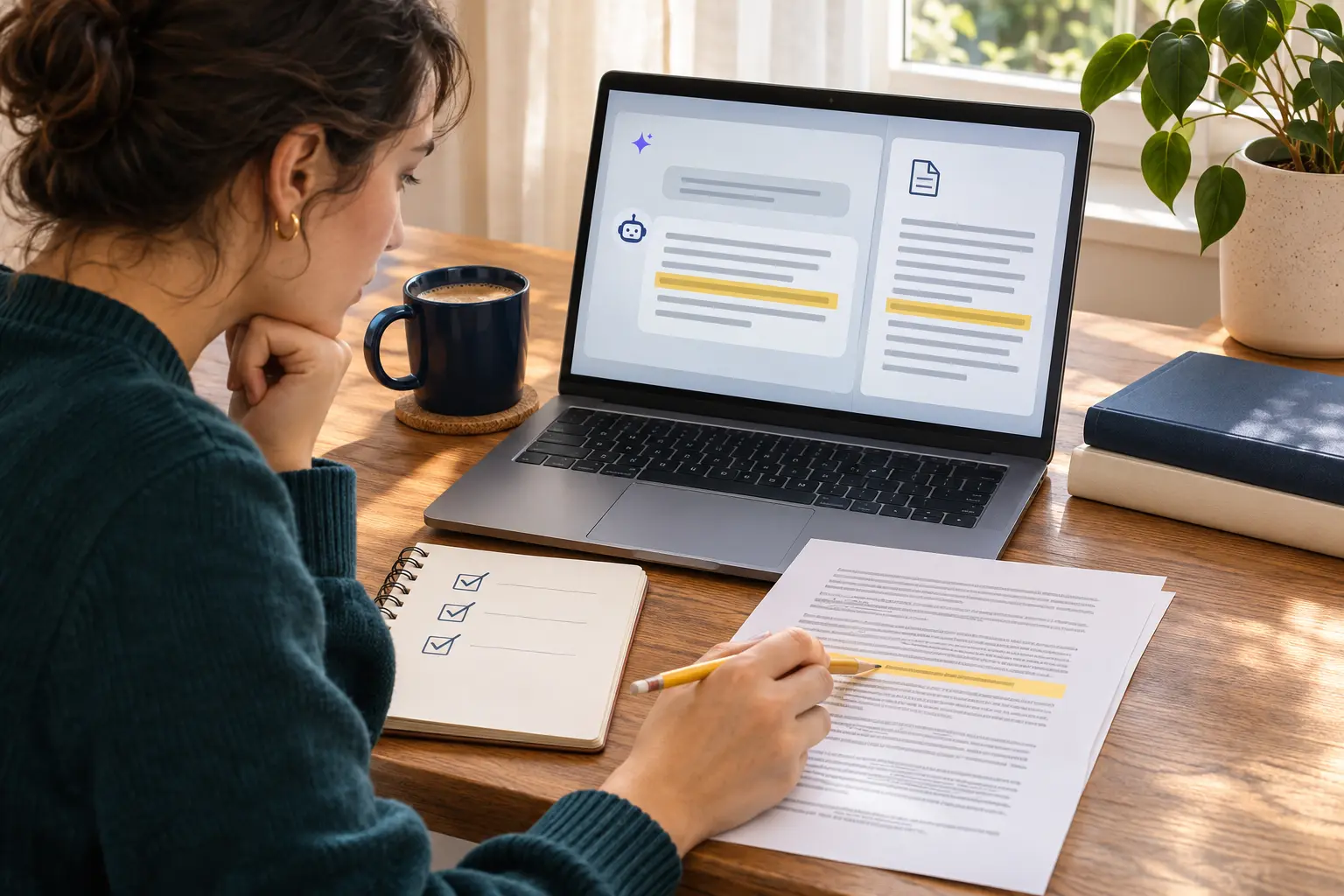
Read the response with a pencil or a separate note open. Mark names, dates, prices, quantities, quotations, comparisons, and statements about who qualifies. Then identify which ones your next decision depends on. A mistaken deadline may matter more than a harmless background description.
Do not label the whole paragraph reliable merely because one detail is correct. An event can exist while its date, entry conditions, and advertised price are all misreported. Treat those as separate questions with separate evidence.
NIST’s Generative AI Profile describes the risk of systems confidently presenting false content, including misleading logic or citations. This explains why fluency alone is a poor checking method; it does not establish that every response is false.
A useful first pass might produce four rows: claim, evidence needed, finding, and action. Keep that list short enough to work through. Our nonfiction note-taking guide provides a related way to preserve the source and meaning of information you want to use.
How do you find the evidence behind a citation?
Open the cited link and establish what it actually is. Is it the original provider’s notice, the underlying study, a news report about it, or an unrelated page on the same website? A familiar domain can host material that does not support the sentence in front of you.
Search the page for a distinctive phrase or relevant number, then read the surrounding passage. A search snippet may omit a qualification. If the page gives a reference to an original report, follow that trail where accessible and record which document you actually read.
Boston University Libraries’ verification guide recommends searching exact titles and then author names or keywords when an AI-supplied reference cannot be located. If you still cannot establish that it exists, do not cite it as evidence. A librarian or subject specialist may help resolve an ambiguous reference.
An inaccessible source is not automatically false. It is simply not something you have verified in full. Use an accessible authoritative alternative, narrow the claim to what you can support, or leave it out. Do not invent a quotation to fill the gap.
What should you compare inside the original source?
Compare scope as carefully as the headline fact. A rule for members is not a rule for everyone. A study of a particular group does not establish the same result for all people. A price without delivery is not the complete cost of an order.
| Claim type | Check inside the evidence |
|---|---|
| Date or deadline | Publication date, event date, revision, and relevant time zone. |
| Price or quantity | Currency, units, included costs, and conditions. |
| Quotation | Exact wording, speaker, surrounding context, and omissions. |
| Comparison or conclusion | Population, period, method, and whether the source makes that comparison. |
Cornell University Library’s research guidance warns that generated material can be outdated, incomplete, or made up and that references need checking. For current arrangements, look for an updated first-party notice rather than assuming an older summary remains authoritative.
Recompute calculations from the stated inputs. Keep a discount amount separate from the resulting price, and check whether the discount is still available. An answer can contain correct arithmetic applied to conditions that no longer hold.
Finally, distinguish evidence from inference. A source saying that a workshop includes practice does not prove that every attendee becomes proficient. Keep the final wording within what the evidence actually supports.
What does a complete fact-checking example look like?
The following workshop, provider notice, and AI-style response are entirely invented for this exercise. They are not a real event, an actual model test, or a source you should cite elsewhere.
Start with the misleading summary
A reader checks on 18 November 2026. The draft says: “The workshop is on 21 November, welcomes families, and costs £18 with the 20% early-booking discount.” It sounds convenient, but contains claims that require different checks.
The fictional provider’s current notice says: workshop on 28 November 2026; adults aged 18 and over; standard fee £30; a 20% early-booking discount only for bookings made before 15 November. The reader keeps a note of the notice version used.
| Draft claim | Evidence check | Action |
|---|---|---|
| 21 November | Notice gives 28 November. | Correct the date. |
| Welcomes families | Eligibility is adults 18+. | State the adult eligibility. |
| Discounted price £18 | 20% of £30 is £6; an eligible price would be £24. | Correct the arithmetic, then check eligibility. |
| Early discount applies | Checking date is after the stated cutoff. | Use the £30 standard fee for this case. |
Write the answer the evidence permits
The corrected summary is: “The current provider notice lists 28 November 2026, adults aged 18 and over, and a £30 standard fee. The early-booking discount ended before this checking date.” Availability would still need checking before booking because the notice does not establish a remaining place.
The result is not merely a better number. The reader has corrected the date, removed a misleading audience description, separated arithmetic from eligibility, and identified an unanswered practical question. That is what a complete check should leave visible.
Can another AI or a better prompt finish the check for you?
An AI tool can help list claims, compare text you provide, or suggest questions to investigate. A prompt such as “Separate facts, calculations, and assumptions; show the source passage for each factual statement” can make the checking work easier to organize.
The evidence still needs inspection. Asking the same system whether it is sure may produce a more elaborate defense of an error. Agreement between two systems does not show that either consulted a reliable independent source.
Count’s claim-by-claim discussion distinguishes sourced statements, calculations, data, and assumptions. The practical lesson is to choose the check that fits the claim, rather than looking for one tool that certifies the entire answer.
Before uploading documents for comparison, check the service’s current data-handling arrangements and your organization’s rules. Use public or appropriately redacted material when you do not have permission to share private information.
For a separate learning use, our AI study-tutor guide keeps the learner attempting the work. Fact-checking is a complementary task: here you are deciding whether an assertion is supported before relying on it.
How do you record a defensible final answer?
Keep the source title or provider, link or file reference, relevant passage, and checking date beside each important claim. You need enough information to find the evidence again and explain what you concluded, not a large archive of screenshots with no labels.
Use clear status words in your private working note: supported, corrected, unresolved, or removed. If evidence conflicts, describe the conflict and seek the appropriate authority. Do not combine incompatible statements into a smooth average.
Before sharing, read the final text again without the original draft. Check that no outdated date or unsupported promise survived the edit. Cite the source you actually inspected, and follow any required disclosure rules for AI assistance.
Your AI Learning Coach is a related catalogue option for broader practical learning. Whatever tool or guide you use, keep the last decision tied to evidence you can revisit.
Conclusion
Take one answer you intend to reuse and identify the three claims most important to your decision. Verify each against its original evidence, then rewrite the answer with any limits still visible. Stop short of certainty when the evidence stops short.
Frequently Asked Questions
Do I need two sources for every fact?
Not as a mechanical rule. A current first-party notice may be the appropriate authority for its own event date, while a disputed scientific claim needs a different depth of investigation. Check independence and relevance rather than counting websites that repeat the same statement.
What if an AI answer has no links?
Treat its factual claims as unverified starting points. Search for the relevant original source yourself, or ask the system for possible references and verify them independently. If a central claim cannot be supported, remove it or state that you could not confirm it rather than using the absence of a link as permission to assume.