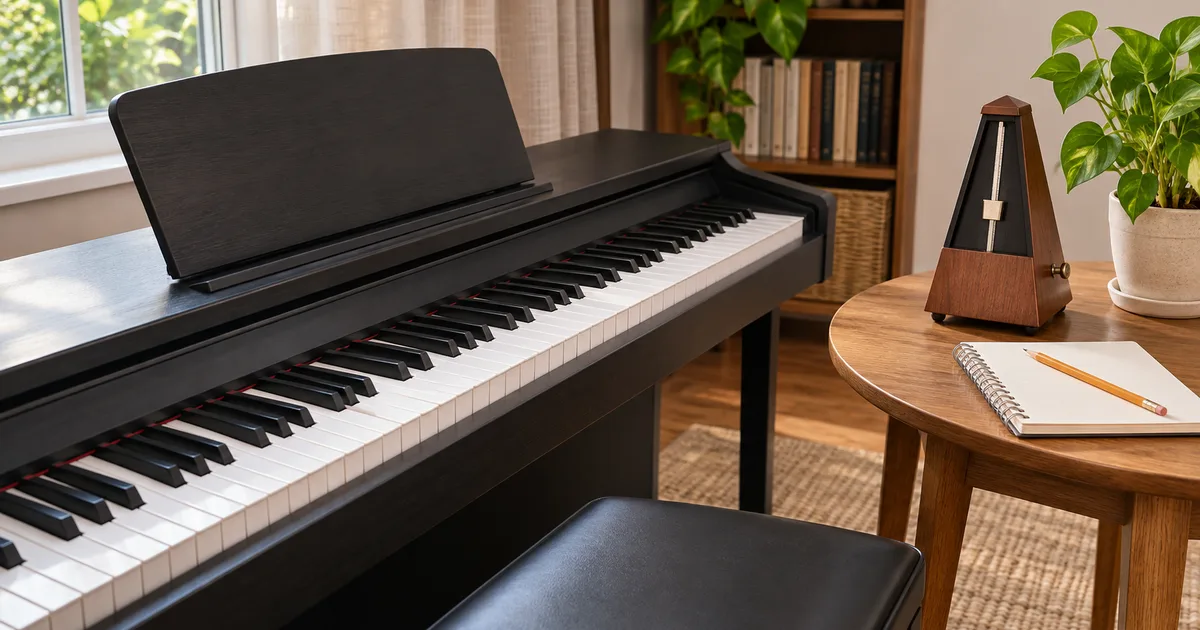
To practice piano with a metronome, choose a short passage you already understand, set one click for each beat, and count before you begin. Use a tempo that lets you play without stopping. If you lose your place, identify the exact beat where it happened before changing the speed.
The exercise below uses only C, D, and E in the right hand. Its purpose is to make a silent beat and a held note feel as clear as a note you strike. You will learn how to start, what to listen for, and how to decide whether the next attempt needs a slower tempo or a simpler task.
Key Takeaways
- Decide what each click represents before playing.
- Keep counting during rests and sustained notes.
- Solve unfamiliar notes or fingering before testing timing.
- Increase the tempo only when the same passage remains controlled.
What does each metronome click mean?
A metronome gives regular reference points. The number on the device usually indicates beats per minute, or BPM. At 60 BPM, the clicks are one second apart. For this beginner exercise, each click represents one quarter-note beat, and four clicks make one bar of 4/4.
Count one, two, three, four across those clicks. Start again at one without pausing after four. If your device can accent the first beat, that can help you hear the bar boundary. A plain unaccented click also works; your spoken count supplies the grouping.
Listen for a few bars before touching the keys. Then tap lightly on your leg while counting. You are checking whether you can join the pulse comfortably. If speaking and tapping already feel disconnected, spend another short attempt there before adding pitch.
Yamaha’s metronome exercises explore different ways to place clicks, including leaving more space between them. Those are useful later. Begin with the straightforward one-click-per-beat setting so the device and your count are giving you an unambiguous reference.
What tempo should you start with?
Choose a familiar fragment rather than a whole piece. Find its notes and decide the fingering without the metronome first. If you pause to identify a key, the immediate problem is note recognition. Speeding up or slowing down the click cannot supply that missing decision.
Try 60 BPM as a starting experiment for the exercise in this guide. It is a convenient number to count, not a universal beginner standard. If that feels rushed, lower it. If the gaps feel so large that you lose the beat, count smaller divisions rather than assuming slower must always be easier.
Change one demand at a time
Play just one note on each beat before adding the melody. Keep your hand comfortable and the sound easy to control. Next, add the pitches while retaining the same count. If your hand becomes tense or uncomfortable, stop and reset; a tempo target never requires pushing through pain.
Your starting tempo is the one at which you can listen as well as play. Write it beside the passage. A note such as “right hand, two bars, quarter-note click at 56” will tell you more tomorrow than simply remembering that practice went well.
How do you count a rest without losing the beat?
A rest removes a sound from the piano, while the beat continues. Count the silent beat at the same pace and with the same place in the bar as the sounding ones. Do not use it as extra preparation time for the next note.
Say “one, two, rest, four” over four clicks, then return to counting all four numbers. Your voice should give the silent beat its full space. You can tap four times while clapping only on beats one, two, and four to separate the pulse from the sounding rhythm.
A held note requires a related distinction. You strike it once and let it continue for its written duration. Counting two beats under one sound does not mean striking the key twice. Listen to the note decay while the clicks mark how much time has passed.
- For a silent beat, keep the count and leave the key unplayed.
- For a two-beat note, press once and count both beats.
- For a new bar, continue directly from four to one.
- After a mistake, finish the count before restarting the short exercise.
What does a complete two-bar exercise look like?
Place your right thumb on middle C, index finger on D, and middle finger on E. Use fingers one, two, and three respectively. Keep the left hand out of this exercise so your attention stays on counting, rather than introducing a second coordination task.
| Bar | Beat 1 | Beat 2 | Beat 3 | Beat 4 |
|---|---|---|---|---|
| First | Play C | Play D | Rest | Play E |
| Second | Play E | Play D | Play C | Keep holding C |
Give yourself one complete count-in bar. Play the first bar with a note on one, a note on two, silence on three, and a note on four. In the second bar, play E on one, D on two, and C on three. Hold C through four and release at the next one.
Listen for the first point that changes
Imagine you try this at 60 BPM and arrive at the first E early. The notes are correct, but the rest has become shorter than one beat. Remove the pitches, tap the rhythm while counting all four beats, and notice where the silent third beat belongs.
Now try the melody at 56 BPM. Suppose you keep the rest for a full beat and hold the final C through the last click. The useful result is a specific correction: you preserved time when the piano was silent. Repeat to see whether that correction survives another attempt.
For the separate challenge of coordinating hands, use our first hands-together exercise. Keep that work distinct until you can identify which part of the task needs your attention.
How should you decide whether to raise the tempo?
Let repeatability choose the next tempo. Listen for a steady count, correct note lengths, comfortable movement, and an uninterrupted bar boundary. One successful attempt can happen by chance. A few consistent attempts give you a more useful basis for changing the setting.
Try a small increase, such as two BPM, and compare the same features. If the rest disappears again, return to the last comfortable setting and work on that beat. The next step is smaller timing work, not repeatedly forcing the faster version.
Separate mistakes in your notes. “Wrong D after the rest” suggests a pitch or preparation issue. “E arrived before beat four” identifies timing. “C struck twice instead of held” concerns note duration. Each observation points to a different practice action.
The London Piano Institute discusses slow metronome work and alternating practice with and without the device. Its tempo suggestions are one teaching approach. Use the sound and comfort of your own attempt to judge what is appropriate for this passage.
When should you switch the metronome off?
After a controlled repetition, stop the device and play the same two bars while counting internally. Notice whether the rest still has space and the final C still lasts two beats. You are checking what remains when the external reference disappears.
If you record yourself, listen to one short take. Find the first early entrance or shortened hold, rather than trying to judge everything about your playing. A recording can also show that a passage felt rushed even though its overall pulse stayed reasonably consistent.
Keep some playing for musical shape as well. Once the timing is settled, try a gentle rise toward the first E and a quieter ending. Do not add elaborate phrasing while you are still finding the keys. Each new demand should leave you able to hear the original rhythm.
Piano Mastery is a related BestDigiBooks guide for broader practice and interpretation. End today’s session by recording the tempo, the particular beat you checked, and what happened without the click. That gives your next session a useful starting point.
Conclusion
Try the two-bar exercise with a full count-in. Listen specifically to the silent third beat and the final held C. When both remain clear across repeated attempts, test a small tempo increase or one attempt without the click, then record what changed.
Frequently Asked Questions
Do I need a separate metronome if my keyboard has one?
A built-in metronome can be enough if you can set a comfortable tempo and hear the beat clearly. Check the keyboard manual for its controls. A separate device is useful when access or visibility is awkward, but the exercise does not depend on buying one.
What if I cannot hear the click while playing?
Lower the piano volume if your instrument permits it, move the metronome closer, or choose another click sound at a comfortable volume. Try a single-note version first. A visual beat indicator can supplement the sound, but avoid twisting your posture to watch it while reaching for the keys.