
You have saved the recommendations. Watched the videos. Maybe bought a few books that are still waiting to be opened.
Yet when you finally have time to read, the same question returns: What should I read next?
A bestseller list can give you ideas, but it cannot tell you what fits your life right now. The book that helps a new parent may be completely different from the one a freelancer needs—or the one you want when work has crowded out every creative interest.
Here is a useful place to start:
Choose your next nonfiction book by identifying one question you want answered, checking the book’s scope and credibility, and finding a format you can realistically use.
That question might concern your work, your relationships, your meals, or something you have always wanted to learn.
This guide explores ten nonfiction categories and shows how to choose a book in each one. You do not need to improve every part of your life at once. You just need a worthwhile place to begin.
Start With Your Life, Then Choose Your Book
Before browsing another collection of covers, complete this sentence:
“Right now, I would like to understand or get better at ______.”
Be specific enough that you could recognize a useful answer.
“I want to be healthier” could mean learning about exercise, understanding a health concern, or finding dinners you can actually cook after work. Each points toward a different book.
“I want to be more confident” might mean speaking to clients, meeting new people, or starting a creative hobby without worrying about being bad at it.
Use this table to narrow your choice.
| What you want right now | Category to explore | What to look for |
|---|---|---|
| Perspective on change, setbacks, or purpose | Biographies & Memoirs | A thoughtful life story with context and credible sourcing |
| Help with a business task or AI workflow | Business & AI | Practical examples, realistic costs, and clear limitations |
| A more manageable personal routine | Self-Help & Personal Growth | Specific exercises and adaptable approaches |
| A clearer understanding of a wellness topic | Health & Wellness | Qualified expertise, reliable references, and appropriate boundaries |
| A hobby you can start from scratch | Arts & Creative Skills | Beginner lessons, demonstrations, and small projects |
| Guidance for your child’s current stage | Parenting & Babies | Age-appropriate information and trustworthy sources |
| A simpler personal-care routine | Beauty & Self-Care | Clear explanations without excessive product pressure |
| A sustainable approach to training or eating | Fitness & Nutrition | Realistic progression and guidance suited to your circumstances |
| Better communication or dating confidence | Dating & Relationships | Respect, consent, boundaries, and practical examples |
| Less stress around everyday meals | Healthy Recipes & Cookbooks | Accessible ingredients and instructions that fit your kitchen |
Two categories may appeal to you. Start with the one that addresses the most immediate question; the other can wait.
1. Biographies & Memoirs: When You Need Perspective
Sometimes you want to spend time with someone else’s story.
Biographies and memoirs let you explore how a person navigated ambition, uncertainty, relationships, loss, or public responsibility. Their value can lie in the complicated parts: the decisions made without knowing how things would turn out.
The distinction between the two matters. A biography is written about someone’s life, while a memoir presents selected experiences through the writer’s own perspective.
When choosing, consider whose viewpoint you are reading and how the account supports its claims. A compelling story can still leave important questions unanswered.
Look beyond whether the subject is famous. Ask whether their experiences connect with something you genuinely want to understand.
Try this after reading: Write down one decision that surprised you. What constraints shaped it, and which of those circumstances differ from your own?
2. Business & AI: When You Want to Make Work Easier
Business and AI books are most useful when you bring them a defined problem.
Perhaps you spend too long drafting customer replies. Perhaps you need a clearer offer, a way to organize research, or a better process for planning content.
A practical guide should show how to approach a task, what a usable result looks like, and where human judgment is still needed. For AI topics, check when the material was written or updated. Interfaces, features, and pricing can change.
Distinguish a useful workflow from a sweeping income promise. Learning to draft a proposal more efficiently is a concrete goal. Expecting a tool to create a profitable business by itself leaves too much unexplained.
Try this after reading: Test one workflow on a low-stakes task. Compare the result with your usual approach, including the time spent checking and correcting it.
3. Self-Help & Personal Growth: When Your Plans Keep Stalling
You may already know what you want to do. The difficulty is fitting it into an ordinary week.
A useful self-help book can help you examine the gap between your intentions and your routine. It might offer exercises for setting priorities, handling distractions, or breaking a large task into smaller steps.
Choose a book that makes room for your actual circumstances. Advice built around uninterrupted mornings may be difficult to apply if you work shifts or care for young children.
Read a sample exercise before buying. Can you imagine using it on a busy Tuesday, or does it require a life you do not currently have?
Try this after reading: Turn one suggestion into a specific plan: “After lunch on Saturday, I will spend fifteen minutes organizing the first part of this project.”
Then adjust based on what happens.
4. Health & Wellness: When You Want Clearer Information
Health and wellness books can help you learn terminology, understand general guidance, and prepare better questions for a healthcare professional.
This category deserves careful selection. Check the author’s relevant qualifications, the quality of the references, and whether the book distinguishes established evidence from uncertainty.
Be cautious with explanations that attribute many unrelated symptoms to one cause or promise a simple cure for everyone. A responsible guide should explain its scope and acknowledge when individual assessment matters.
Specificity helps here, too. “Understanding sleep routines” is a clearer reading goal than “fixing my entire health.”
Try this after reading: Make a short list of questions you would like to discuss with a qualified professional. Keep questions separate from conclusions about your own health.
A book can inform that conversation; it cannot provide an individualized diagnosis.
5. Arts & Creative Skills: When You Miss Making Things
Perhaps you have wanted to paint, learn guitar, or take better photographs for years. You keep postponing it because you expect the first attempts to look unimpressive.
A beginner guide should give you a comfortable way into those first attempts.
Look for clearly explained fundamentals, manageable equipment requirements, and small projects that build on one another. Preview any diagrams or demonstrations: can you follow them without already knowing the skill?
For painting, a first lesson might explore mixing a few colors. For guitar, it might explain how to hold the instrument and practice a simple transition. For photography, it could show how light changes an everyday subject.
Try this after reading: Make one small thing before moving to the next chapter. Keep the result, including the mistakes, so you have something concrete to compare with later.
6. Parenting & Babies: When Advice Feels Overwhelming
Parenting advice can become a flood of competing instructions. One source recommends a strict routine; another tells you to follow your instincts.
Start with your child’s current stage and your specific question. A guide about infant feeding serves a different purpose from one about toilet learning or communicating with an older child.
Look for age-appropriate information, reliable references, and explanations that recognize variation between children. Notice whether the author discusses when professional support is appropriate.
The tone matters as well. Guidance should help you understand your options without making every difficult day feel like a personal failure.
Try this after reading: Note the question you wanted answered, the guidance you found, and anything you still need to clarify with your child’s healthcare professional.
You do not need to adopt an entire parenting philosophy to use one helpful explanation.
7. Beauty & Self-Care: When You Want a Simpler Routine
A beauty routine can expand until it becomes difficult to remember why you bought each product.
A useful beauty and self-care book should help you understand your priorities. You might want clearer information about product categories, a more manageable hair-care routine, or a personal-care ritual you enjoy.
Look for explanations that distinguish essential steps from optional ones. Consider whether the recommendations fit your budget, preferences, and available time.
Be wary of advice that treats constant purchasing as the main route to feeling good about yourself. Good information should make your choices easier to explain.
Try this after reading: Review your existing routine. For each step, write down its purpose. If you cannot explain why something is there, make a note to investigate before adding anything else.
For persistent skin or scalp concerns, seek appropriate professional advice.
8. Fitness & Nutrition: When You Want a Plan You Can Keep Using
The first question is whether a book fits your starting point.
A demanding training guide may be a poor match for someone returning to movement after a long break. A detailed nutrition plan may be difficult to use if it assumes ingredients, equipment, or preparation time you do not have.
Look for explanations of technique, gradual progression, recovery, and adaptation. Nutrition guidance should acknowledge that individual needs differ.
The World Health Organization notes that some physical activity is better than none and that all physical activity counts. That supports a flexible starting point rather than dismissing small amounts of movement.
Try this after reading: Identify one realistic action you can repeat and a simple way to record it.
If you have a health condition, an injury, or other circumstances affecting exercise or nutrition, get guidance suited to you.
9. Dating & Relationships: When You Want Better Conversations
A useful relationship book should help you participate in relationships with greater clarity and respect.
That might mean learning to express a preference, recognize a boundary, manage expectations, or approach a first date with less pressure.
Look for examples of actual conversations. Does the book explain how to listen and respond, or does it rely on slogans? Does it respect the other person’s freedom to disagree?
Avoid guides built around manipulation, guaranteed attraction, or rigid assumptions about how all men or women behave. Other people are not outcomes you can control.
Try this after reading: Practice expressing one preference clearly: “I would enjoy seeing you again. Would you like to meet next week?”
Clarity gives both people room to respond honestly. That is a useful skill whether the relationship continues or ends.
10. Healthy Recipes & Cookbooks: When Dinner Is the Daily Problem
A cookbook can be useful long before you cook every recipe in it.
The right one may simply help you answer the question that arrives at the end of each workday: “What can I make with the time and ingredients I have?”
Preview several recipes. Check the full preparation time, required equipment, serving sizes, and whether ingredients are easy to find where you live.
Choose around your routine. Quick dinners, budget cooking, meal preparation, and high-protein recipes address different needs. The word “healthy” alone does not tell you whether a recipe suits your dietary requirements.
Try this after reading: Pick three recipes with overlapping ingredients. Use them to make a short shopping list and a realistic plan for the week.
A few repeatable meals may be more useful than an ambitious menu you never cook.
How to Judge a Nonfiction Book Before Buying
Once you have chosen a category, use these five checks to compare individual books.
Read the Table of Contents
Does the book address your question directly?
A broad title can sound relevant while giving your topic only a few pages. The contents should reveal the scope, sequence, and level of detail.
Open a Sample
Choose a page from the main text, not just the introduction.
Check whether the explanations make sense to you. For instructional books, inspect a lesson, exercise, or recipe. You are evaluating how usable the material is.
Check Who Created It
Relevant expertise depends on the subject. A memoir relies on a different kind of authority from a health guide.
Look for a clear author or publisher identity and enough information to evaluate the work. Attractive design does not establish accuracy.
Examine the Promise
Notice the difference between “learn the fundamentals” and “become an expert instantly.”
A trustworthy description should make the likely value clear without promising control over health, income, other people, or every aspect of your life.
Choose a Format You Will Use
An ebook may suit reading on your phone or returning quickly to a chapter. A printed book may suit your preference for physical pages and handwritten notes.
For visual instruction, check how the sample displays on your intended device. A detailed diagram that looks fine on a large screen may be difficult to use on a small one.
Turn Your Next Read Into One Small Experiment
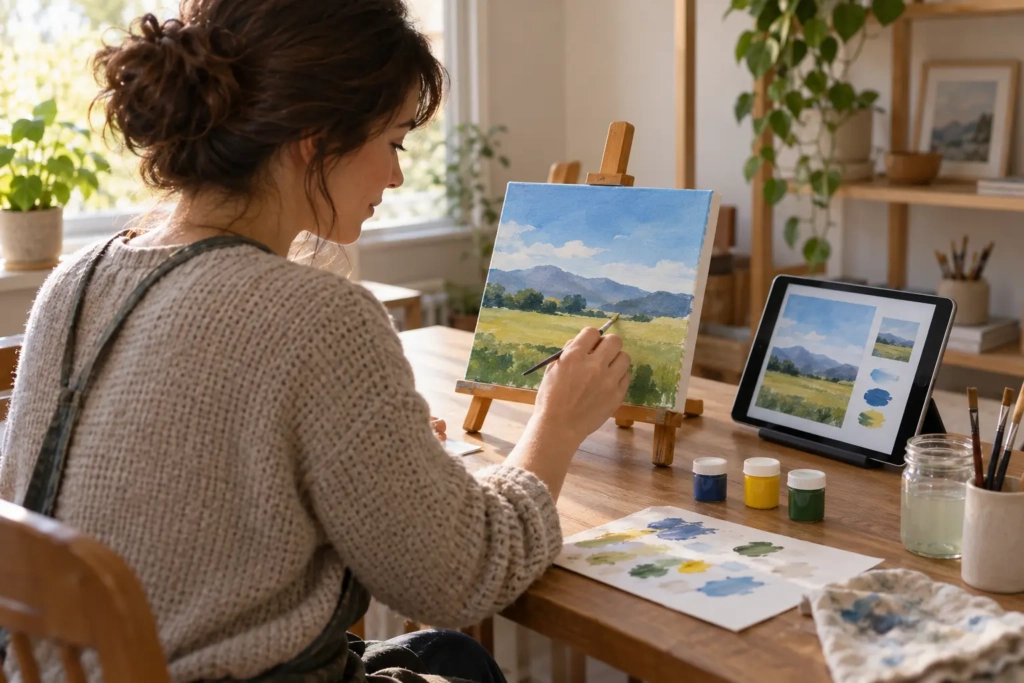
You do not need to finish a whole book before doing something useful with it.
Try this simple sequence:
- Name your question. Write down what you hope the book will help you understand.
- Read a relevant section. Start with enough context to understand the advice properly.
- Choose one appropriate action. It could be a practice exercise, a recipe, a reflection, or a question for a professional.
- Notice what happened. Record what was useful, confusing, difficult, or enjoyable.
- Decide what comes next. Continue, adapt your approach, or choose a different resource.
For a memoir, the experiment might be a journal entry about a decision. For a creative guide, it could be a ten-minute practice session. For a cookbook, it is a meal.
The action should suit the book. Some reading is valuable because it gives you perspective or enjoyment; it does not need to become another productivity project.
Frequently Asked Questions
How do I choose a nonfiction book if I have several goals?
Start with the question that matters most this month. Compare books on how directly they address it, then save the other topics for later. You can have several interests without pursuing all of them at once.
Should I read self-help books or biographies?
Choose self-help when you want explicit exercises or a practical framework. Choose a biography or memoir when you want to explore experiences, decisions, and another person’s perspective. A sample will help you judge which approach appeals to you.
How can I tell whether a health or parenting book is reliable?
Check relevant qualifications, references, publication or revision dates, and the scope of its advice. Be cautious with universal promises. For decisions concerning your health or your child’s care, use qualified professional guidance.
Do I have to finish every nonfiction book I start?
No. You can read selected chapters when the structure allows it, although some instructions require earlier material. If the book does not address your question or suit your level, choosing a more relevant resource is reasonable.
Are ebooks suitable for learning practical skills?
They can be, depending on the quality of the instructions and how well diagrams, photographs, and navigation work on your device. Use a preview to check readability before choosing.
Choose the Question That Matters to You
Your next read could be a life story, a beginner’s painting lesson, a practical business guide, or a cookbook that makes Wednesday dinner easier.
Start with the question you actually have. Then choose a book that explains its subject clearly, respects its limits, and fits the way you live.
You can explore the BestDigiBooks collection to find your next subject and compare it with your current interests.
Before you browse, ask yourself:
If a book could help me understand one thing better this month, what would I choose?
Share your answer in the comments—or send this guide to someone who keeps asking what to read next.
This article provides general reading guidance. Books about health, nutrition, parenting, and wellbeing do not replace individualized professional advice.
